
Sleep anxiousness is concern or fear about not having the ability to go to sleep or keep asleep, and it will probably preserve you awake by itself. The lure is that attempting exhausting to sleep, watching the clock, and bracing for a nasty night time elevate alertness, which makes sleep tougher and the concern stronger. Analysis on insomnia factors to fret, security behaviors, and sleep monitoring as key gas for this loop. Cognitive behavioral remedy for insomnia (CBT-I) is the best-supported repair, and it additionally eases anxiousness signs. At residence, attempt dropping the hassle, turning the clock away, writing worries down earlier, and getting up if you’re awake and wired. A concern of sleep itself, known as somniphobia, is extra intense and wishes skilled care. That is academic info, not medical recommendation.
What’s sleep anxiousness?
Sleep anxiousness is concern or fear about going to sleep, normally about not having the ability to go to sleep or keep asleep. It’s generally known as efficiency anxiousness about sleep, since you really feel it’s important to carry out and concern you’ll fail.
Some sources use “sleep anxiousness” and “somniphobia” for a similar factor. Here’s a extra helpful strategy to inform them aside:
- Sleep anxiousness: you need to sleep and concern you’ll not. Fear spikes close to bedtime, and it’s possible you’ll watch the clock and rely the hours you may get.
- Somniphobia: an intense concern of falling asleep itself, which might trigger extreme anxiousness and lead individuals to keep away from sleep. Folks might concern nightmares, sleep paralysis, or dying of their sleep. Diagnosing a particular phobia normally requires signs lasting about six months.
- Insomnia dysfunction: hassle falling or staying asleep a minimum of three nights per week for a minimum of three months, with misery or impairment. Sleep anxiousness is a standard gas for it, so the 2 typically overlap.
What does sleep anxiousness really feel like?
It typically seems to be like this:
- Dread or pressure as bedtime approaches, and even when you concentrate on sleep.
- Racing ideas, a quick heartbeat, restlessness, or a tense physique.
- Clock-watching and sleep math: “If I go to sleep now, I’ll solely get 5 hours.”
- Checking a sleep tracker and letting the rating set your temper.
- Protecting habits, equivalent to cancelling plans, napping, or mendacity in mattress longer to make up for a nasty night time.
These protecting habits have a reputation within the analysis: security behaviors. They really feel useful, however they will preserve the concern alive.
Why does concern of not sleeping preserve you awake?
As a result of sleep is supposed to occur robotically, and energy and a spotlight intrude with it. Two well-known fashions clarify the loop.
Harvey’s cognitive mannequin says insomnia is maintained by a cascade of 5 processes: fear with arousal and misery, selective consideration and monitoring, misperceiving how unhealthy your sleep and daytime deficits are, unhelpful beliefs about sleep, and counterproductive security behaviors.
Espie and colleagues describe an consideration–intention–effort pathway. You begin to discover sleep (selective consideration), you set a agency intention to sleep, and also you attempt tougher (sleep effort). Collectively these take away the automated high quality of sleep.
The end result: the concern itself turns into the wake-up sign. The following night time, your thoughts braces for an additional unhealthy one.
How are you going to ease sleep anxiousness? A step-by-step plan
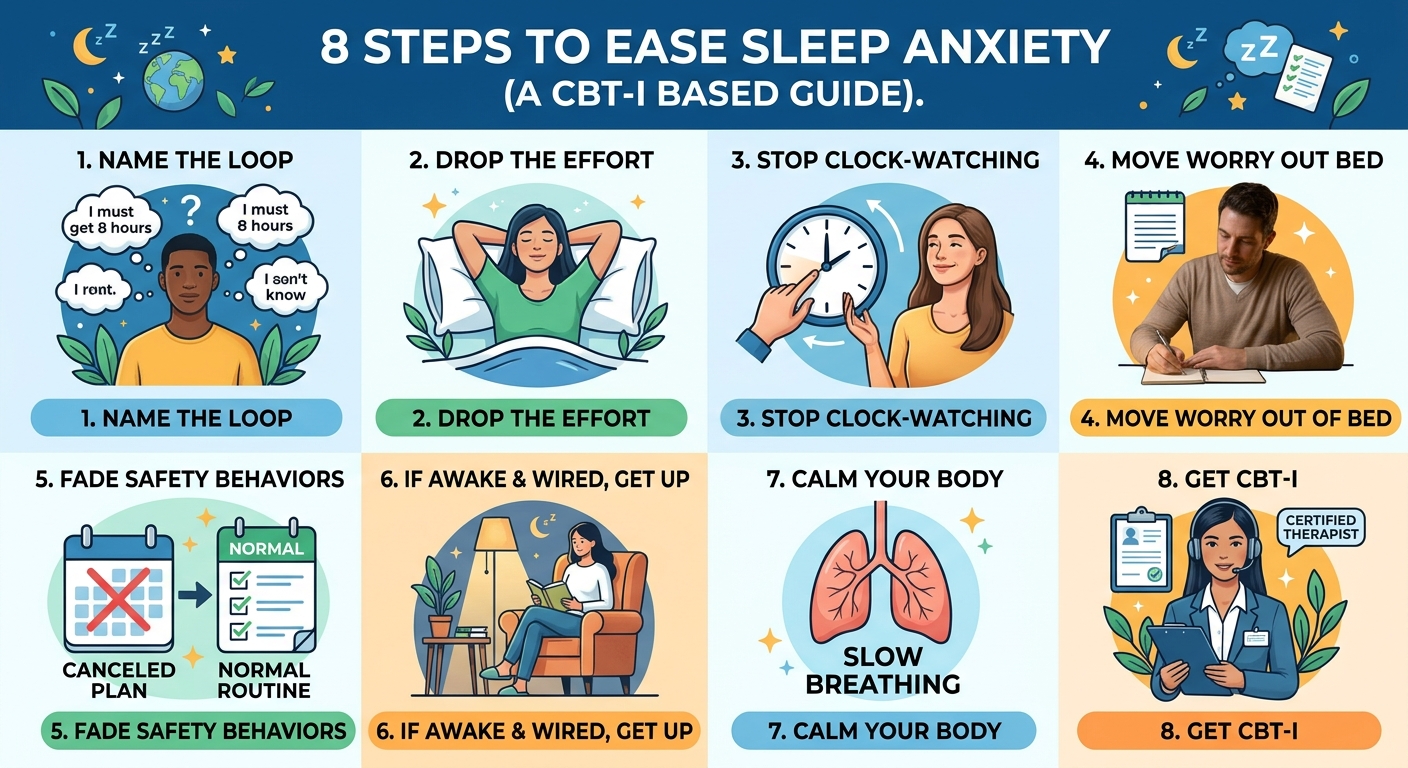
These steps come from the fashions above and from commonplace CBT-I strategies. Collectively, they’re the best-supported route, and no single trick is confirmed by itself:
- Identify the loop. Discover ideas like “I have to get eight hours” or “I can’t perform after a nasty night time.” Unrealistic expectations about sleep and its penalties are known as dysfunctional beliefs, and remedy is proven to alter them.
- Drop the hassle. You can not drive sleep. Goal for relaxation and calm, and let sleep arrive by itself.
- Cease clock-watching and score-keeping. Flip the clock away. Contemplate checking your sleep tracker much less typically. See sleep tracker accuracy.
- Transfer fear off the bed. Write tomorrow’s to-do checklist and worries earlier within the night. In a single lab examine, a five-minute to-do checklist helped younger adults go to sleep about 9 minutes quicker. See cognitive shuffling for a bedtime psychological software.
- Fade security behaviors. Discover what you do to guard sleep, equivalent to cancelling plans, napping, or staying in mattress longer. Check what occurs once you stick with it usually after a nasty night time. Researchers recommend behavioral experiments for this.
- In case you are awake and wired, stand up. Do one thing calm in low mild till you are feeling sleepy, then return to mattress. That is stimulus management, a core CBT-I software.
- Calm your physique. Sluggish respiration and rest can decrease arousal. See how to calm anxiety before bed and racing thoughts at night.
- Get CBT-I if it lasts. The American Faculty of Physicians recommends CBT-I because the first-line therapy for power insomnia. Examine CBT-I.
Does the concern of not sleeping take over your evenings, it doesn’t matter what you attempt? If you need to see how we’d have the ability that can assist you with this deeper, schedule a free consult here.
Does treating sleep anxiousness assist your anxiousness total?
Partly. CBT-I improves sleep and reasonably reduces anxiousness, however it’s not a alternative for treating an anxiousness dysfunction.
An older meta-analysis of 72 trials discovered that insomnia therapy had a reasonable impression on co-existing anxiousness signs. A 2022 assessment discovered that CBT-I is efficient in individuals with a psychological dysfunction and insomnia, with the clearest results for melancholy, post-traumatic stress dysfunction, and alcohol dependence. A 2023 meta-analysis discovered that digital CBT-I diminished anxiousness and melancholy signs in addition to insomnia. So treating the sleep downside typically helps, and it’s price doing alongside take care of any anxiousness dysfunction.
Is it somniphobia? When sleep anxiousness turns into one thing extra
Somniphobia is a particular phobia. The Cleveland Clinic notes that folks might concern nightmares, sleep paralysis, or dying of their sleep, and that folks with post-traumatic stress dysfunction usually tend to develop it, as a result of trauma could cause night time terrors and different sleep disturbances. Specialists have no idea precisely what causes it.
Ask your self:
- Is your concern intense, and out of proportion to the precise hazard?
- Do you keep away from sleep, or panic when it’s time for mattress?
- Does it intrude together with your relationships, work, or psychological well-being?
- Has it lasted six months or extra?
If sure, see a psychological well being skilled. Therapy is much like different phobias and will embody cognitive behavioral remedy or publicity remedy. A physician may additionally think about medication in some circumstances, and it ought to solely be taken underneath supervision.
What the Analysis Exhibits
Sleep is computerized, and energy and a spotlight break it. Espie and colleagues’ 2006 assessment in Sleep Medication Evaluations proposed the eye–intention–effort pathway for psychophysiological insomnia, with three elements: selective consideration to sleep, express intention to sleep, and sleep effort. Comply with-up work on the College of Glasgow discovered that folks with this sort of insomnia selectively attend to sleep-related stimuli, an consideration bias that turns into a efficiency deficit as presentation time will increase. Harvey’s 2002 mannequin provides fear, monitoring, misperception, unhelpful beliefs, and security behaviors.
Fear and security behaviors predict who develops and retains insomnia. A longitudinal examine reported in Frontiers in Psychology (2021) discovered that extra security behaviors and extra somatic arousal elevated the chance of growing insomnia later, and that fear additionally raised the chance. Amongst individuals who already had insomnia, extra fear about sleep predicted persistence slightly than remission, whereas much less selective consideration and monitoring and fewer security behaviors over time predicted remission. These are associations, and the researchers known as the help “partial.”
CBT-I modifications beliefs and security behaviors. A 2015 randomized trial in Cognitive Behaviour Remedy in contrast on-line CBT-I with a ready checklist. It discovered that reductions in sleep-related security behaviors and dysfunctional beliefs helped clarify the profit on insomnia. The authors instructed that therapy could possibly be improved by fading security behaviors extra totally, for instance via behavioral experiments.
CBT-I additionally helps anxiousness, to a reasonable diploma. A 2022 meta-analysis in Sleep Medication Evaluations reported that nearly 70% of sufferers with psychological issues report sleep difficulties and about 30% meet standards for insomnia dysfunction. It discovered steady medium to giant results of CBT-I on insomnia in individuals with a comorbid psychological dysfunction. A 2023 meta-analysis of digital CBT-I discovered important results on anxiousness and melancholy, and the consequences had been greater in individuals who caught with this system. The American Faculty of Physicians recommends CBT-I as first-line therapy for power insomnia.
This text is for schooling solely and isn’t medical recommendation. Discuss with a certified clinician about your personal sleep, well being situations, and medicines.
If you need to see how we’d have the ability that can assist you with this deeper, schedule a free consult here.
Desire a hand breaking the fear-of-not-sleeping loop?
Be a part of The Sleep Nirvana Membership, our free sleep course and group: Join the free sleep course and community.
When to Search Skilled Assist
- You could have hassle sleeping a minimum of three nights per week and it has lasted weeks to months, or the concern of not sleeping impacts your work or relationships. Ask about CBT-I.
- You could have an intense concern of sleep itself, keep away from sleep, panic at bedtime, or have trauma-related nightmares. A psychological well being skilled can assist.
- You’re feeling persistently unhappy or hopeless, or have ideas of self-harm. Contact a clinician straight away, and within the US you’ll be able to name or textual content 988 at any time.
- You depend on alcohol or sleep medication to calm the concern. Discuss with a clinician about safer choices.
- You wake abruptly with a racing coronary heart or gasping, otherwise you snore loudly. Bodily causes equivalent to sleep apnea can really feel like anxiousness at night time.
Often Requested Questions
What’s sleep anxiousness?
Sleep anxiousness is concern or fear about not having the ability to go to sleep or keep asleep. It typically reveals up as dread close to bedtime, racing ideas, clock-watching, and a tense physique. It will possibly create a loop: fear raises alertness, sleep will get worse, and the following night time feels scarier. Analysis fashions of insomnia spotlight fear, selective consideration to sleep, and security behaviors as key drivers. It’s treatable, and cognitive behavioral remedy for insomnia (CBT-I) is the first-line strategy.
Is sleep anxiousness the identical as somniphobia?
Not precisely, though some sources use the phrases loosely. Sleep anxiousness is fear about not getting sufficient sleep. Somniphobia is an intense concern of falling asleep itself, typically tied to nightmares, sleep paralysis, trauma, or concern of dying in sleep, and other people might keep away from sleep. A analysis of a particular phobia normally requires signs lasting about six months. In case you panic at bedtime or keep away from sleep, see a psychological well being skilled about remedy equivalent to CBT or publicity remedy.
How do I cease being anxious about not sleeping?
Decrease the hassle and the monitoring. Flip the clock away, cease checking sleep tracker scores, and write tomorrow’s worries and to-do checklist earlier within the night. In case you are awake and wired, stand up and do one thing calm in low mild till sleepy. Discover habits like cancelling plans or napping to guard sleep, as a result of these security behaviors can feed the concern. If it lasts for weeks, ask about CBT-I, which has one of the best proof.
Why do I get extra anxious about sleep as bedtime will get nearer?
Anticipation is a part of the loop. When you have had unhealthy nights, your thoughts might begin bracing for an additional one, which raises pressure and application on the very time you’ll want to chill out. Insomnia analysis describes selective consideration and monitoring, fear, and unhelpful beliefs about sleep as widespread sustaining components. Over time, the mattress can even turn into linked with wakefulness. CBT-I works on these patterns straight, together with getting off the bed if you find yourself awake and wired.
Does CBT-I assist sleep anxiousness?
Sure. CBT-I modifications the beliefs and habits that preserve sleep anxiousness going, equivalent to security behaviors and unrealistic expectations about sleep. In a single randomized trial, modifications in security behaviors and dysfunctional beliefs helped clarify how on-line CBT-I diminished insomnia. Evaluations additionally discover that CBT-I eases comorbid anxiousness signs to a reasonable diploma. The American Faculty of Physicians recommends CBT-I as the primary therapy for power insomnia. It isn’t a alternative for therapy of an anxiousness dysfunction.
When to Work With a Sleep Marketing consultant
If the concern of not sleeping runs your evenings, there could also be deeper drivers: a stress response that stays switched on, your circadian rhythm, hormones, blood sugar swings, or nutrient gaps. The Sleep Marketing consultant seems to be for these root causes as an alternative of handing you generic sleep-hygiene ideas, and works alongside a clinician once you want remedy for anxiousness.
Schedule a free sleep assessment.
Trending Merchandise

COONP King Mattress Topper, Extra T...

CoolShields Waterproof Bed Pads Inc...

Nordic Elk Mattress Bags for Moving...

Waterproof Mattress Protector Twin ...

Utopia Bedding Waterproof Mattress ...

BEDLORE Waterproof Mattress Protect...

Queen Mattress Protector Waterproof...
