
Sleepwalking in adults is a sleep problem through which a part of the mind stays asleep whereas one other half wakes, so that you rise up and transfer or act with out being conscious of it. It often occurs in deep non-REM sleep in the course of the first third of the night time. About 3.6% of US adults sleepwalked previously yr. Widespread triggers embrace sleep deprivation, stress, alcohol, untreated sleep apnea, some drugs, and despair. The principle purpose is security: lock doorways and home windows, clear the ground, and repair the set off. See a sleep physician if episodes are frequent, trigger harm, or observe a brand new sleep drugs. The FDA has a boxed warning for sleepwalking with zolpidem, eszopiclone, and zaleplon. That is academic info, not medical recommendation.
What’s sleepwalking in adults?
Sleepwalking, additionally referred to as somnambulism, is a parasomnia. Meaning an undesirable occasion that comes together with sleep. It’s an arousal from non-REM (NREM) sleep, the deepest stage of sleep. Throughout an episode, the mind is partly awake, so you are able to do advanced issues, however you aren’t consciously conscious of your actions. The American Academy of Sleep Drugs (AASM) says episodes most frequently happen within the first third of the night time.
It isn’t only a childhood downside. The AASM says as much as 4% of adults sleepwalk. In a big US survey, about 3.6% of adults had an episode previously yr, and most of the people who sleepwalked as youngsters had stopped. Sleepwalking was not strongly linked to gender, and it appeared to lower with age.
Here’s what an grownup episode can seem like:
- You sit up in mattress together with your eyes open and a clean stare.
- You rise up and stroll or do routine duties, resembling opening doorways or shifting issues round.
- You reply slowly or by no means, and you could appear confused.
- You keep in mind nothing within the morning.
- You could return to mattress by yourself, or go to sleep some other place.
Adults could dream or hallucinate throughout an episode, in response to the AASM. Sleepwalking additionally typically happens with sleep terrors, which come from the identical stage of sleep.
What causes sleepwalking in adults?
There’s hardly ever one trigger. Most adults have a built-in tendency plus triggers that tip them over. Listed here are the widespread ones:
- Household historical past and genes. About 30% of sleepwalkers in a big US survey had a household historical past. A gene variant referred to as HLA-DQB1*05:01 was present in 35% of sleepwalkers in a single examine, in contrast with about 13% of individuals with no sleep problem.
- Sleep deprivation and a disrupted schedule. The Mayo Clinic lists sleep deprivation, stress, fever, and schedule modifications resembling journey.
- Alcohol. Consuming can intervene with sleep and will set off sleepwalking.
- Sleep apnea and different sleep problems. The AASM says sleepwalking can happen when sleep is fragmented by different sleep issues, and treating sleep apnea could enhance it.
- Melancholy, nervousness, and obsessive-compulsive dysfunction. Folks with despair have been 3.5 occasions extra more likely to sleepwalk within the 2012 survey, and other people with obsessive-compulsive dysfunction have been 4 occasions extra doubtless.
- Medicines. Over-the-counter sleep aids and prescription hypnotics have been linked to sleepwalking. Zolpidem, eszopiclone, and zaleplon carry an FDA boxed warning, lined beneath.
As a result of grownup sleepwalking is extra more likely to be confused with, or to exist alongside, different sleep and medical situations, a sleep physician often seems on the entire image. Our article on Ambien side effects covers what the FDA warnings say.
Is sleepwalking in adults harmful?
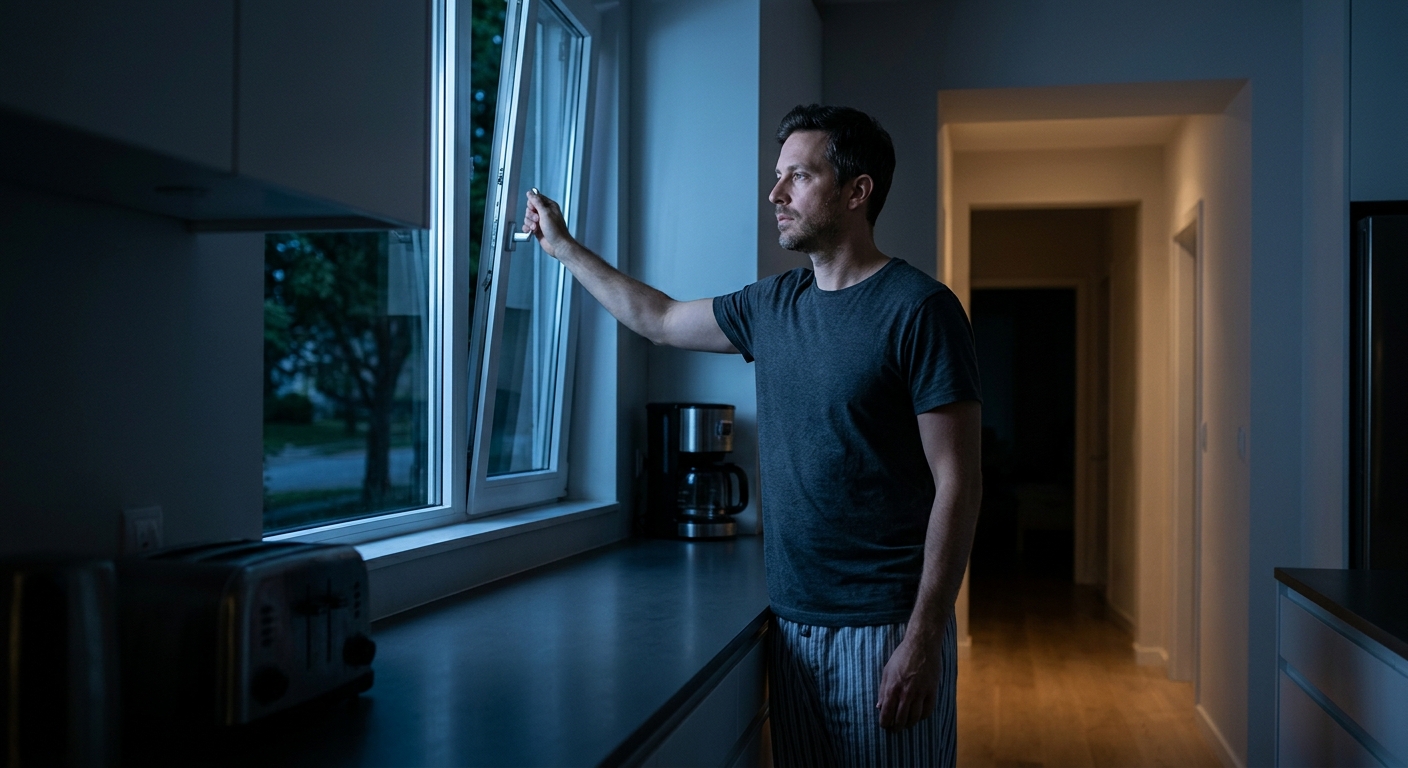
It may be. Don’t assume it’s innocent. Accidents can occur from falls, strolling into objects, or leaving the home. The AASM notes that in adults, males usually tend to present aggressive habits throughout an episode.
In a examine of 100 grownup sleepwalkers (ages 18 to 58, median age 30), researchers discovered extra daytime sleepiness, fatigue, insomnia, depressive and nervousness signs, and a decrease high quality of life than in individuals who didn’t sleepwalk. The lead writer mentioned that grownup sleepwalking, often considered benign, is a probably critical situation whose penalties shouldn’t be ignored.
In a small 2002 convention report of 16 sufferers, 32% reported violent incidents and 19% reported accidents throughout sleepwalking. That pattern is tiny, so deal with the numbers as a flag, not a prediction.
Are you sleepwalking, or waking exhausted and not sure why? If you need to see how we’d have the opportunity that will help you with this deeper, schedule a free consult here.
How is sleepwalking in adults recognized?
A sleep physician evaluations your medical historical past and signs, and your mattress companion’s account is effective. The AASM says the physician will attempt to discover something that causes it or makes it worse, resembling one other sleep problem, and will order a sleep examine.
It issues to inform sleepwalking aside from lookalikes:
- Sleep terrors additionally come from NREM sleep and infrequently occur alongside sleepwalking.
- REM sleep habits dysfunction occurs in REM sleep, when the physique usually can not transfer, and includes performing out desires. The 2 can overlap in some adults.
- Different situations can seem like sleepwalking. MedlinePlus notes that in older adults, new sleepwalking could sign a medical downside that impacts psychological operate, so it deserves a medical analysis.
Need the broader image of night-time behaviors? See our guides to sleep talking in adults, sleep paralysis, and hypnic jerks, or our parasomnias overview.
How do you cease sleepwalking in adults? A step-by-step plan
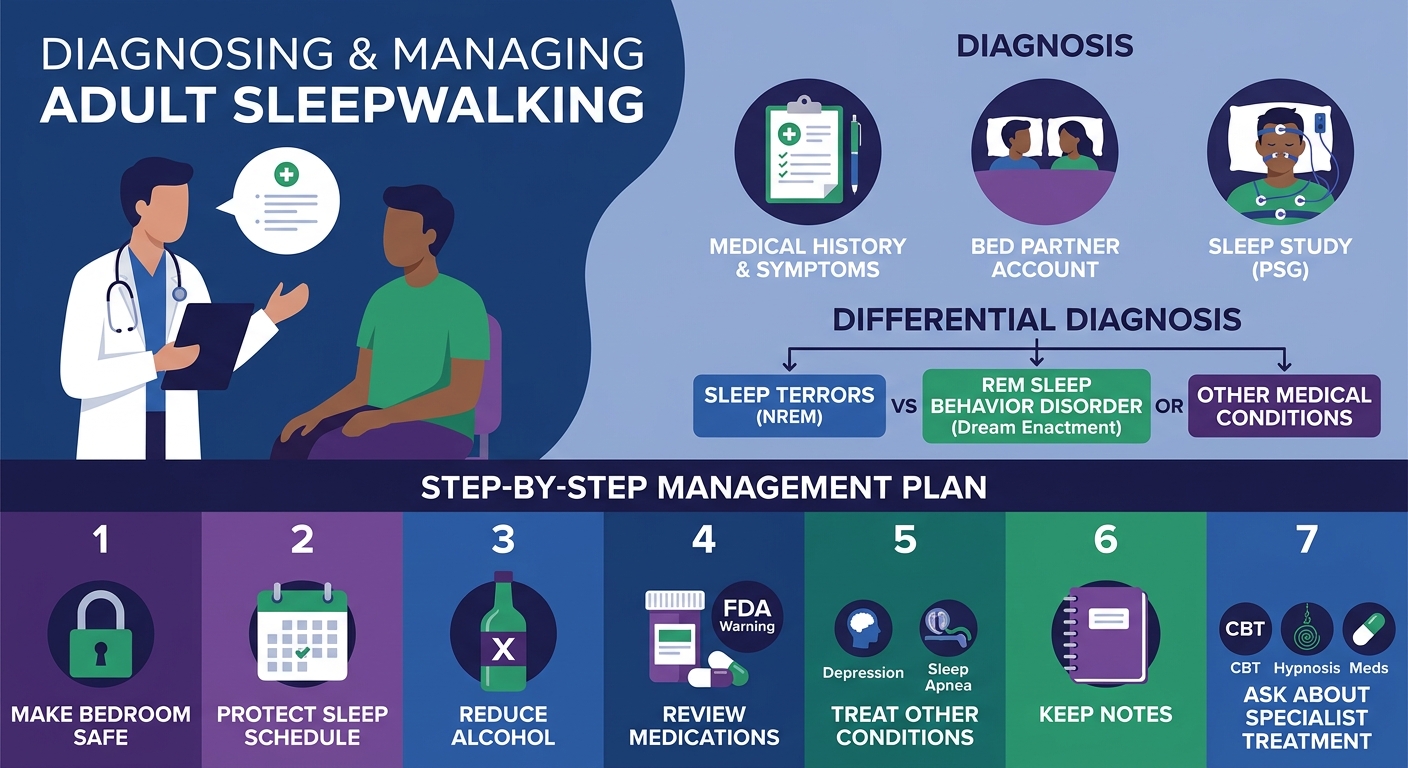
Begin with security and triggers, then see a health care provider if it continues. The Mayo Clinic says remedy usually focuses on selling security and eliminating causes or triggers. Here’s a sensible order:
- Make the bed room secure. Lock doorways and home windows, clear the ground, and transfer sharp or breakable objects. A researcher who led the biggest US survey advises ensuring there’s a lock on the door and window. Take into account a chime or alarm on the bed room door.
- Shield your sleep. Preserve a daily schedule and get sufficient hours. Sleep deprivation is a typical set off.
- In the reduction of on alcohol, particularly within the night.
- Assessment your medicines together with your prescriber or pharmacist. In case you sleepwalk or do issues you don’t keep in mind after zolpidem, eszopiclone, or zaleplon, the FDA says to cease the drugs and speak to your well being care skilled instantly.
- Deal with different situations. Sleep apnea, insomnia, despair, and nervousness can all play an element. Learn our complete guide to sleep apnea.
- Preserve notes. Write down when episodes occur, how lengthy they final, and what you probably did. It helps your physician.
- Ask about remedy if episodes proceed or are harmful. A sleep specialist can focus on choices resembling cognitive behavioral remedy, scheduled awakenings, and hypnosis, and in chosen instances drugs.
In case you share a house, right here is commonsense recommendation. Keep calm, and gently information a sleepwalking individual again to mattress relatively than confronting them. Some persons are confused or aggressive when woken. Preserve your distance if they appear agitated.
What the Analysis Exhibits
It’s extra widespread in adults than individuals thought. A 2012 Neurology examine surveyed 19,136 adults in 15 US states by telephone. About 3.6% (about 8.4 million individuals) had a sleepwalking episode previously yr, and about 1% had two or extra in a month. Lifetime prevalence was 29.2%, largely due to childhood episodes. Sleepwalking was not tied to gender, and it appeared to lower with age. About 30% had a household historical past.
Melancholy, obsessive-compulsive dysfunction, and alcohol are linked. In the identical survey, individuals with despair have been 3.5 occasions extra more likely to sleepwalk, and people with obsessive-compulsive dysfunction have been 4 occasions extra doubtless. About 3.1% of individuals with despair sleepwalked twice a month or extra, in contrast with 0.9% of these with out it. For obsessive-compulsive dysfunction the figures have been 7.3% versus 1%. Alcohol abuse was additionally related. Over-the-counter sleep aids, hypnotics, and SSRIs have been linked as effectively, though the lead writer mentioned the hyperlink with zolpidem was weaker than some studies counsel and that despair itself is the likelier root for SSRI customers. The survey can not present trigger and impact.
Grownup sleepwalking impacts daytime life, and genes play a task. A 2013 examine in SLEEP in contrast 100 grownup sleepwalkers with controls and located extra daytime sleepiness, fatigue, insomnia, depressive and nervousness signs, and altered high quality of life. A 2003 examine of 60 sleepwalkers discovered HLA-DQB10501 in 35% versus 13.3% of controls (odds ratio 3.5). A small 2002 report discovered 50% of 16 sufferers carried the HLA DQB105 susceptibility versus 24% of wholesome individuals, and 11 of 53 sufferers examined had sleep apnea.
Therapy proof is skinny, and a few sleep medicine trigger sleepwalking. A 2023 systematic assessment in Sleep Drugs discovered 76 publications on behavioral and psychological therapies for NREM parasomnias, 44 of them in adults. Hypnosis was the commonest remedy. Examine designs and inconsistent consequence measures restricted the proof, however some supported multicomponent CBT, sleep hygiene, scheduled awakenings, and hypnosis. Individually, in 2019 the FDA added a boxed warning and a contraindication to eszopiclone, zaleplon, and zolpidem after discovering 66 instances over 26 years of advanced sleep behaviors that prompted critical accidents, together with deaths. These behaviors occurred even on the lowest advisable doses and after a single dose.
This text is for training solely and isn’t medical recommendation. Discuss with a professional clinician about your personal sleep, well being situations, and drugs.
If you need to see how we’d have the opportunity that will help you with this deeper, schedule a free consult here.
Need a hand with the sleep habits behind night-time arousals?
Be a part of The Sleep Nirvana Membership, our free sleep course and neighborhood: Join the free sleep course and community.
When to Search Skilled Assist
- Your episodes are frequent, you might have been harm, or you might have put your self or others in danger, for instance by leaving the home, cooking, driving, or performing aggressively. See a sleep physician promptly.
- Sleepwalking began after you started a sleep drugs, particularly zolpidem, eszopiclone, or zaleplon. Contact your prescriber instantly, because the FDA advises.
- Sleepwalking is new later in life, you act out desires, or episodes contain stiffening, jerking, or repeat the identical means a number of occasions an evening. Ask for a medical analysis, since different situations can seem like sleepwalking.
- You snore loudly, gasp or choke at night time, or really feel very sleepy by day. These can sign sleep apnea.
- You’re feeling persistently unhappy, anxious, or hopeless, or have ideas of self-harm. Contact a clinician instantly, and within the US you may name or textual content 988 at any time.
Ceaselessly Requested Questions
What causes sleepwalking in adults?
Grownup sleepwalking often comes from a mixture of a built-in tendency and triggers. A household historical past is widespread, and one gene variant, HLA-DQB1*05:01, is extra frequent in sleepwalkers. Triggers embrace sleep deprivation, irregular schedules, stress, fever, alcohol, sleep apnea, despair, nervousness, and a few medicines. Episodes occur when the mind is partly awake throughout deep non-REM sleep, typically within the first third of the night time. A sleep physician can search for the triggers that apply to you.
Is sleepwalking in adults an indication of a psychological well being downside?
Not essentially, however there’s a hyperlink. In a survey of greater than 19,000 US adults, individuals with despair have been 3.5 occasions extra more likely to sleepwalk, and people with obsessive-compulsive dysfunction have been 4 occasions extra doubtless. Alcohol issues have been additionally related. The examine can not present what causes what, and lots of sleepwalkers haven’t any psychological well being situation. If in case you have temper or nervousness signs together with sleepwalking, point out each to your physician.
How do I cease sleepwalking as an grownup?
Begin with security and triggers. Lock doorways and home windows, clear the ground, and think about an alarm or chime on the bed room door. Get sufficient sleep on a daily schedule, reduce on alcohol, and ask your physician or pharmacist whether or not any medicines may very well be concerned. Deal with sleep apnea or different sleep problems if in case you have them. If episodes proceed or are harmful, a sleep specialist can focus on choices resembling cognitive behavioral remedy, scheduled awakenings, hypnosis, or drugs.
Is sleepwalking hereditary?
It typically runs in households. In a big US survey, about 30% of sleepwalkers had a household historical past of it. Researchers have additionally linked a gene variant referred to as HLA-DQB1*05:01 to sleepwalking. It was present in 35% of sleepwalkers in a single examine, in contrast with about 13% of individuals with no sleep problem. A gene doesn’t assure you’ll sleepwalk. Triggers like sleep loss, alcohol, and stress nonetheless matter.
Can sleeping tablets trigger sleepwalking?
Sure, some can. In 2019, the FDA added its strongest warning to zolpidem (Ambien), eszopiclone (Lunesta), and zaleplon (Sonata) due to uncommon however critical advanced sleep behaviors, together with sleepwalking and sleep driving, that prompted accidents and deaths. The behaviors can occur even on the lowest advisable doses and after a single dose. In case you sleepwalk or do something you don’t keep in mind after taking considered one of these medicines, cease it and speak to your prescriber instantly.
When to Work With a Sleep Advisor
We don’t diagnose or deal with sleepwalking, and a sleep physician ought to rule out sleep apnea and different problems first. What The Sleep Advisor can do is search for the basis causes that fragment your sleep, resembling an irregular schedule, a burdened nervous system, circadian rhythm issues, hormones, and nutrient gaps, in order that your nights are calmer.
Schedule a free sleep assessment.
Trending Merchandise

COONP King Mattress Topper, Extra T...

CoolShields Waterproof Bed Pads Inc...

Nordic Elk Mattress Bags for Moving...

Waterproof Mattress Protector Twin ...

Utopia Bedding Waterproof Mattress ...

BEDLORE Waterproof Mattress Protect...

Queen Mattress Protector Waterproof...
