
You wake at 6:40 on a Tuesday along with your telephone already glowing on the nightstand, espresso at 8, lunch at your desk round 1, dinner at 9:30 as soon as the home quiets down, then an hour of laptop computer gentle earlier than mattress. Nothing about that day feels uncommon. But each a type of moments palms a timing sign to a small cluster of cells behind your eyes, and people cells determine how warn you’ll really feel tomorrow afternoon.
It is common to deal with a sleep schedule as a matter of self-discipline. Go to mattress earlier, strive more durable, purchase a heavier blanket. The clock that governs when sleep arrives is about by cues, although, and self-discipline solely modifications the cues you are uncovered to. Get the cues proper and the schedule tends to observe.
Circadian rhythm is managed by a partnership: an inner pacemaker that retains its personal time, plus exterior alerts that nudge it into line with the world. Understanding which sign reaches which clock is what makes the entire system click on.
Desk of Contents
The Cues That Set Your Physique Clock
Circadian rhythm is managed by a pacemaker contained in the mind that will get reset every day by cues from outdoors the physique, and gentle is the strongest of these cues. The pacemaker is a paired cluster of cells within the hypothalamus referred to as the suprachiasmatic nucleus, or SCN. It reads gentle arriving from the eyes and makes use of that studying to line up hormone launch, physique temperature and blood-pressure patterns with the day outdoors.
One mind clock, many organ clocks
That is the grasp clock. Your physique additionally runs a second layer of clocks, one inside almost each organ and tissue: the liver, intestine, pancreas, fats tissue, coronary heart and skeletal muscle all preserve time. These peripheral clocks do not learn gentle in any respect. They learn meals, motion and temperature.
The 2 layers can disagree. Say you go to sleep at 11 and wake at 7, so the mind clock is effectively aligned with daylight, however dinner lands at 10 pm and a snack lands at midnight. Your grasp clock says night time whereas your liver is being informed it is mealtime. That mismatch is why the reply to “what controls circadian rhythm” cannot cease at gentle.
| Cue | Clock it reaches | Predominant impact on timing | Sensible lever |
|---|---|---|---|
| Gentle on the retina | Central SCN grasp clock | Advances or delays the clock relying on when it arrives | Brilliant outside gentle quickly after waking |
| Darkness and melatonin | Pineal gland, downstream of the SCN | Rising melatonin promotes sleepiness as darkness begins | Dim lighting within the hours earlier than sleep |
| Core physique temperature | SCN and peripheral clocks | Tends to fall towards sleep and rise towards waking | Heat bathe 1 to 2 hours earlier than mattress |
| Meal timing | Liver, intestine, pancreas and different peripheral clocks | Can shift metabolic timing independently of sunshine | End dinner a number of hours earlier than mattress |
| Train | Muscle and different peripheral clocks | Acts as a non-light timing cue and modifications efficiency | Practice at a constant time of day |
| Social and work schedule | Total every day behavioural rhythm | Units recurring sleep and wake occasions | Maintain the wake time regular, together with weekends |
How robust every cue actually is
The dimensions of the equipment is small and particular. Older academic materials from the U.S. National Institute of Neurological Disorders and Stroke estimates that the paired SCN incorporates roughly 20,000 neurons. The identical materials describes managed isolation experiments during which, with out regular gentle and time cues, human organic timing drifts towards a cycle of roughly 25 hours slightly than precisely 24.
That drift explains why the clock wants every day upkeep. Left alone it runs lengthy, which is why a free weekend with out an alarm can depart you falling asleep later by Sunday night time.
The rating that issues: gentle resets the clock every day, whereas meals, train and routine fine-tune it. Repair gentle and a gradual wake time first. Every thing else is adjustment, not basis.
Earlier than you learn on, write down the 5 greatest timing cues in your personal week. The 7 am alarm, the 8:15 espresso, the 12:30 lunch, the 6 pm health club slot, the ten pm snack. That record is your beginning stock.
How the Mind’s Grasp Clock Retains Time
Consider an orchestra. The conductor stands on the entrance, however each musician within the room already owns a way of the beat. What the conductor provides is a shared reference, so 100 gamers land on the identical tempo as a substitute of drifting into 100 non-public ones.
The SCN is the conductor. Cells all through the physique are the musicians, every preserving its personal every day rhythm, and the SCN’s gentle studying is the downbeat that retains them collectively.
The loop that runs inside each cell
Zoom right into a single cell and the timing mechanism turns into a suggestions loop constructed from proteins. It really works like this:
- Clock proteins construct up. Genes within the nucleus change on and produce proteins similar to PER by way of the day and night time.
- They change off their very own manufacturing. As soon as sufficient protein accumulates, it blocks the gene exercise that made it. Manufacturing stops.
- The protein breaks down. Degradation clears the block over the next hours.
- Manufacturing restarts. With the block gone, the genes change on once more, and the cycle repeats on a roughly 24-hour interval.
That cycle is self-sustaining. A cell does not want gentle to run it, which is precisely why the rhythm survives when exterior cues are stripped away.
A plant in a darkish room, and a fruit fly with a damaged gene
In 1729, the French astronomer Jean-Jacques d’Ortous de Mairan seen that mimosa crops stored opening and shutting their leaves on schedule even inside a light-tight darkish room. That remark grew to become the primary widely known proof that organic rhythms can persist with out direct environmental gentle.
Molecular work accelerated within the Nineteen Seventies, when researchers used fruit flies to hunt for the genes behind every day rhythms. In 1984, Jeffrey Corridor, Michael Rosbash and Michael Younger remoted the Drosophila interval gene and confirmed that its PER protein accumulates through the night time and is degraded through the day, producing an oscillating sign. Later work added genes together with timeless, clock and cycle, and established the transcription and translation suggestions loop mannequin. In 2017 the three obtained the Nobel Prize in Physiology or Drugs for these discoveries, as the Nobel Prize announcement units out.
Here is the mechanism in movement, from the molecule as much as the entire physique:
In mammals, the SCN gathers the retinal gentle sign and synchronizes these mobile oscillators throughout tissues. So timing is managed at two linked ranges: gentle entrainment of the central pacemaker and intracellular clock-gene loops that preserve every tissue by itself beat. Gentle retains the conductor in line with the day. The musicians preserve enjoying regardless.
The Strongest Cue and Why Timing Issues
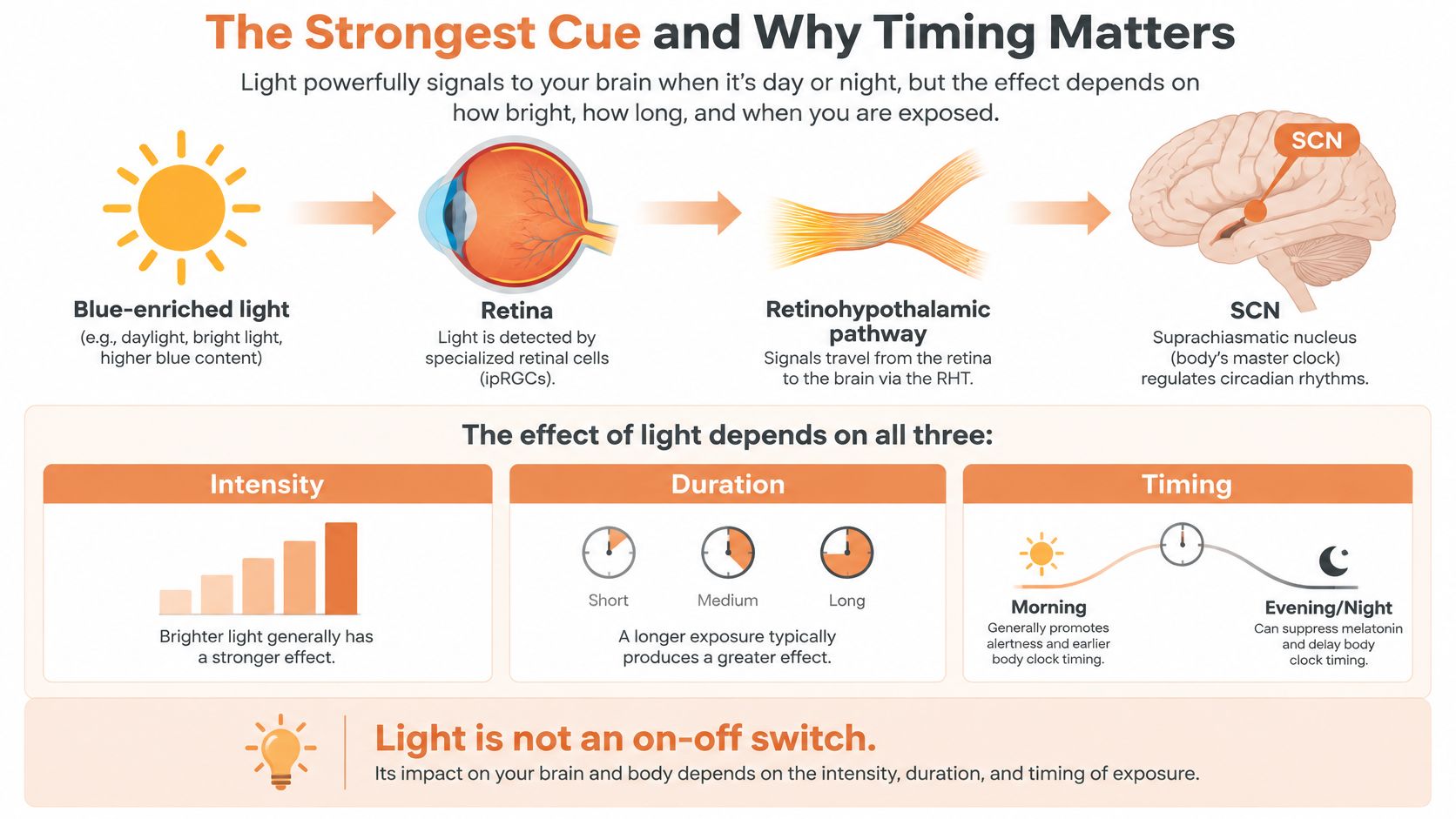
At 7 a.m., outside gentle can pull your physique clock earlier. The identical vibrant gentle late within the night can push it later. The impact is determined by timing, brightness, period, wavelength, and the sunshine your eyes obtained earlier within the day.
Retinal intrinsically photosensitive ganglion cells detect environmental gentle, particularly short-wavelength, blue-enriched gentle. They ship timing data to the mind’s suprachiasmatic nucleus (SCN) alongside the retinohypothalamic pathway. The SCN coordinates clocks in different tissues and helps time bodily rhythms, as research on light and circadian phase describes.
Course is determined by when gentle lands
The physique clock responds to gentle in keeping with a phase-response curve: the identical publicity can shift the clock in reverse instructions at totally different organic occasions. Gentle within the late organic night time and early morning tends to maneuver the clock earlier. Gentle within the late organic day and early night time tends to maneuver it later.
A phase-response curve is sort of a timetable for the clock’s sensitivity. Its timing is organic, not decided by the hour proven in your telephone. So the shift from a given publicity varies with the place your inner clock is in its cycle.
| Gentle publicity | Timing relative to physique clock | Anticipated shift |
|---|---|---|
| Brilliant gentle, 10,000 lux for six.7 hours | Late organic night time to early morning | Advance |
| Brilliant gentle, 10,000 lux for six.7 hours | Late organic day to early night time | Delay |
| Brilliant outside gentle on waking | After the organic night time | Tends to advance the clock |
| Dim night room gentle | Hours earlier than recurring sleep | Tends to delay the clock |
Use the sample as a information, not a assure. To shift towards an earlier wake time, search vibrant gentle within the morning and scale back vibrant gentle late within the night. Night gentle can encourage a later schedule, which can make an early wake-up more durable.
Not all vibrant gentle is equal
Spectrum issues in addition to depth. A 2024 randomized managed trial discovered that violet-excitation LEDs induced 48.6% much less melatonin suppression than blue-excitation LEDs, in keeping with the trial’s published report.
Sensible rule: Set bright-light timing in keeping with the shift you need, not simply the clock on the wall. A 6 a.m. run in winter and one in summer time could expose your eyes to very totally different quantities of daylight.
If mornings are exhausting to suit into your routine, learn how morning sunlight can support sleep quality. Select a goal wake time, then make morning outside gentle a constant behavior earlier than judging its impact.
Melatonin and Temperature as Clock Alerts
You dim the lounge at 10 pm and nonetheless really feel awake. The lamp is low, the display screen is face-down, and sleep is not going to begin. That stall often comes from treating melatonin and physique temperature because the switches that set the clock. They’re the messages the clock sends out, not the palms that flip it.
The mind’s grasp clock, the SCN, reads gentle after which tells the pineal gland when to lift melatonin. Darkness lets that sign rise. Gentle cuts it again. Rising melatonin makes sleepiness extra doubtless, the way in which a hallway dimmer tells the home that night has began with out resetting the fuse field. Organs preserve their very own clocks. Melatonin is a broadcast from the grasp clock, not a personal timer contained in the liver or a muscle. Mixing these two layers up is the standard level of confusion, and it’s why a bedtime dose doesn’t, by itself, retune digestion or morning alertness.
Core physique temperature rides the identical nightly schedule. It tends to fall as sleep approaches and rise earlier than waking. A cool bed room, and a heat bathe timed an hour or two earlier than mattress, work with that fall slightly than towards it. The nightly decline, and what interrupts it, is roofed in body temperature during sleep.
The identical gentle, hours aside
Timing modifications the scale of the shift. In a managed examine of 21 wholesome adults, the peak-to-trough distinction in melatonin section shifting throughout light-timing situations was about 5.02 hours, as reported in controlled light-timing studies. An identical gentle produced very totally different outcomes relying on when it arrived.
Dose sits on the identical night curve. In contrast with a room underneath 1 lux, modest ranges of 10, 30, and 50 lux every pushed obvious melatonin onset later, and the delay grew because the room obtained brighter. Fifty lux continues to be dim. It’s a hallway lamp, or a vibrant pill at arm’s size, not a floodlit kitchen. The curve is steep at ranges that really feel odd.
| Night gentle stage | Impact on obvious melatonin onset |
|---|---|
| Below 1 lux | Reference baseline, little added delay |
| 10 lux | A transparent later shift |
| 30 lux | A bigger later shift |
| 50 lux | The most important later shift of those three |
Flip the dose down at night time
Maintain night gentle low within the hours earlier than your recurring bedtime. Favor one shaded lamp over overhead downlights. If a late schedule wants to maneuver earlier, put the brightest gentle of the day within the morning, when the grasp clock is most keen to advance.
Diagnostic query: if sleep onset retains sliding later whereas your wake time stays fastened, have a look at night gentle earlier than you look anyplace else.
Notice the sunshine stage within the room the place you wind down tonight. Not the entire home. The precise chair, the particular lamp, the particular display screen.
Meals and Train as Secondary Cues
The concept gentle is the one cue is the most typical simplification on this entire matter, and it is fallacious in a approach that issues. Gentle publicity is the first cue for the SCN, however feeding schedules can independently synchronize peripheral clocks within the liver, intestine, pancreas, adipose tissue and coronary heart.
That creates a situation most sleep recommendation ignores. You may wake at 7, see daylight by 7:30, go to sleep at 11, and nonetheless have a metabolic clock operating hours behind as a result of dinners land late and snacks land later. Bettering morning gentle will not absolutely offset consuming through the organic night time.
What late meals really shift
Human analysis on meal timing discovered that late meals delayed plasma-glucose rhythms by roughly 5.69 hours and adipose-tissue PER2 expression by about 0.97 hours, displaying that meal timing shifts metabolic timing even when the light-driven central clock does not transfer equivalently, in keeping with research on meal timing and peripheral clocks.
The trustworthy scope right here is timing, not destiny. Late consuming does not trigger illness. It does imply glucose regulation and internal-clock coordination can shift independently of what number of energy you ate.
Train is a cue with a trade-off
Coaching reaches muscle and different peripheral clocks, so it capabilities as a non-light timing cue. It additionally runs into its personal every day variation: train capability could also be larger within the night for some folks, doubtlessly due to circadian modifications in muscle glucose and fatty-acid metabolism, as a review of circadian timing and metabolism discusses.
The trade-off is actual and directional. Night coaching can help efficiency whereas elevating arousal shut sufficient to bedtime to delay sleep. Early coaching provides a agency behavioural anchor however will be badly mismatched to a real late chronotype. Current chronobiology work factors towards combining train and meal timing to enhance metabolic alignment, although a lot of that mechanistic proof comes from animal fashions and belongs within the speculation column.
Separate your objectives earlier than you choose a slot. Efficiency, glucose management and sleep onset name for various timing choices, and a plan that optimizes one can inadvertently price you one other. If night meals are the piece you wish to work on, carb timing and sleep quality will get into the sensible aspect of transferring dinner earlier.
The place the Proof Is Nonetheless Provisional
A number of widespread claims are already settled effectively sufficient to behave on, so what follows is barely the open floor.
Train timing. Opinions counsel train capability could also be larger within the night, however outcome-specific information for sleep, glucose and efficiency is proscribed and sometimes drawn from small samples. Check it your self by logging efficiency and sleep onset for 2 weeks at one coaching time, then two weeks at one other. Your personal numbers beat a basic suggestion.
Mixed meal and train timing. The concept aligning each improves metabolic coordination rests totally on animal fashions. Deal with it as a speculation price watching, not a protocol to observe.
Chronotype. Genetics units a baseline, and lightweight timing plus routine can shift it, although modifications often take days to weeks slightly than one good morning. A helpful check: maintain your wake time fastened for seven days and be aware when sleepiness rises within the night. That sample tells you the place your clock presently sits.
Meal timing and glucose. The human research present shifted metabolic rhythms. They do not present that late consuming causes illness. The declare stays restricted to timing results which will act independently of calorie amount, which is a narrower and extra defensible assertion.
Weigh it so as. Act first on gentle and a hard and fast wake time, which carry the strongest help and the fewest caveats. Run train timing and mixed timing as private experiments with a begin date and a evaluate date.
Set Your Gentle and Meal Timing This Week
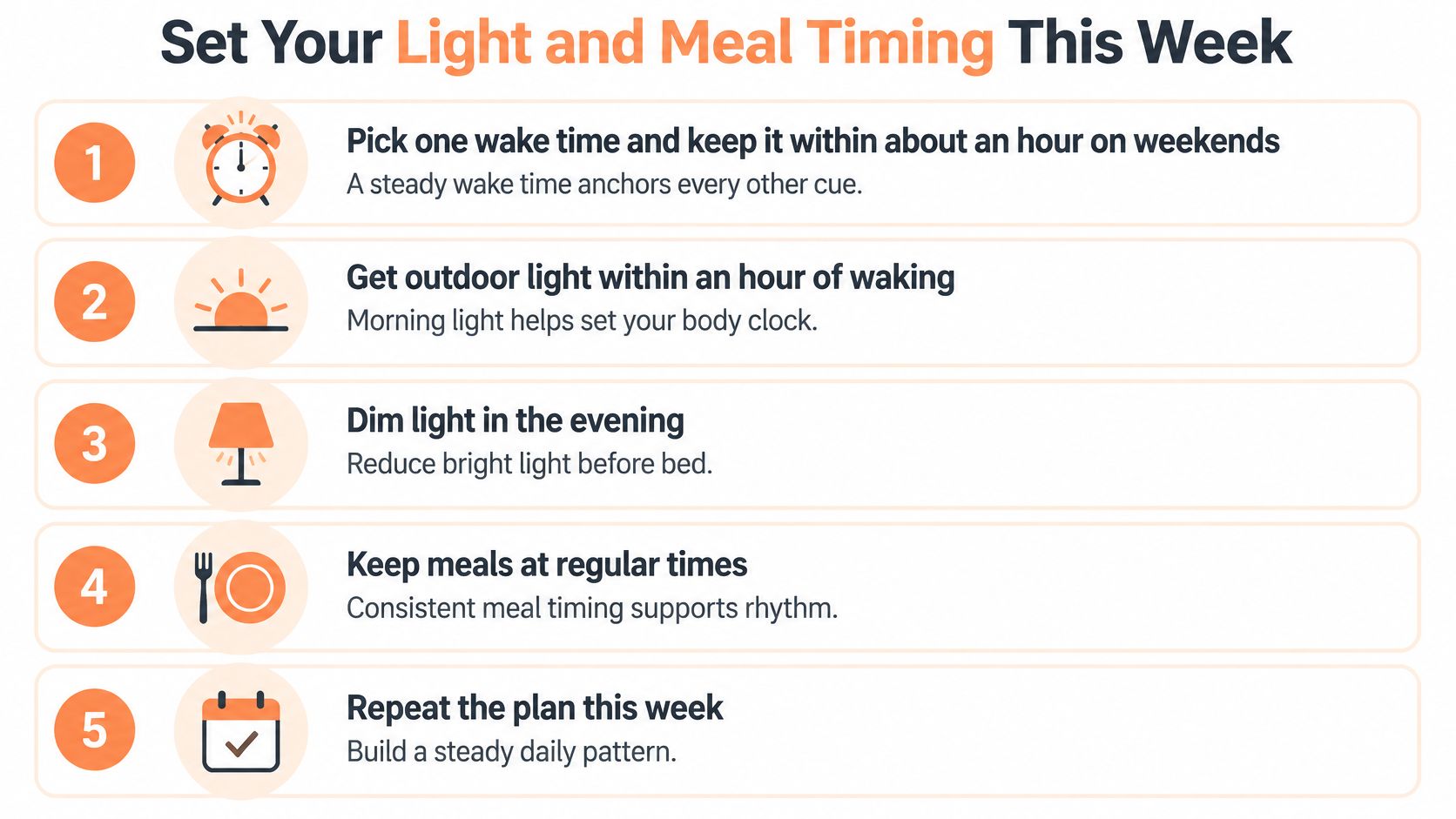
5 steps, within the order that will get you probably the most motion for the least effort. Begin tomorrow slightly than Monday.
- Choose one wake time and maintain it inside about an hour on weekends. A gradual wake time anchors each different cue, and letting it slide two hours on Saturday undoes the week’s work.
- Get outside gentle inside an hour of waking. Morning gentle is the cue that advances a late schedule, and it must be outside or no less than at a vibrant window.
- Dim room lights within the hours earlier than your recurring sleep. Overhead downlights at 10 pm are the most typical reason for a schedule that retains slipping later.
- End dinner a number of hours earlier than mattress. Meals pull peripheral clocks, so a late dinner retains metabolic timing behind the mind clock even when sleep seems high-quality.
- Log sleep onset and wake time for seven days. And not using a document you are guessing which cue moved, and guessing is how folks abandon a plan that was working.
Learn the log like a practitioner. A gradual shift earlier or later over one to 2 weeks means the cues are working, and it’s best to depart them alone. No change in any respect means the cue you selected wants adjusting, not that your clock is damaged.
Another variable price checking: hormonal shifts disrupt sleep timing for loads of folks, and sleep scheduling around hot flashes covers the right way to regulate the plan when night time sweats are a part of the image.
Select the one cue you may change first. Write down the date you may evaluate the log, put that date in your calendar, and produce the log to it. If the sample stays caught after two weeks, a clinician or sleep specialist can evaluate the log with you and test for one thing the cues alone will not repair.
In order for you this dealt with with extra precision than a guidelines permits, The Sleep Guide builds individualized protocols with Riley Jarvis, a sleep guide who has helped CEOs, executives and different professionals repair their sleep and regain their power, focus and well being. The work goes previous basic gentle and meal recommendation into biomarker testing, circadian timing, temperature, supplementation and nightly monitoring, with changes primarily based by yourself information slightly than averages. Go to The Sleep Consultant to begin with a complimentary sleep evaluation and discover out which cue is holding your schedule again.
Trending Merchandise

COONP King Mattress Topper, Extra T...

CoolShields Waterproof Bed Pads Inc...

Nordic Elk Mattress Bags for Moving...

Waterproof Mattress Protector Twin ...

Utopia Bedding Waterproof Mattress ...

BEDLORE Waterproof Mattress Protect...

Queen Mattress Protector Waterproof...
