
Sleep and hair loss get linked continuously on social media, normally by a sequence that goes: poor sleep raises cortisol, cortisol raises DHT, and DHT causes balding. Right here’s the sincere model. A latest systematic assessment seemed straight on the analysis connecting sleep and hair loss. It discovered actual organic pathways price taking critically, but it surely additionally said plainly that present analysis “can not show trigger and impact.” The reviewers referred to as for extra research earlier than anybody attracts a agency conclusion. One a part of the favored chain holds up higher than the remaining: sleep deprivation does seem to lift cortisol, and elevated cortisol is a believable set off for telogen effluvium, a brief, diffuse shedding sample. The DHT hyperlink is weaker. No research on this analysis traces sleep deprivation on to increased DHT ranges, the hormone really answerable for genetic sample baldness. That is instructional info, not medical recommendation.
From the Follow
[RILEY: add a real observation here, for example how often clients connect their hair shedding to a stressful, sleep-deprived stretch, or how you help them distinguish temporary shedding from something that needs a dermatologist.]
What Does the Precise Analysis Say?
A scientific assessment printed in 2025 got down to reply this query straight: does sleep really have an effect on hair loss? The researchers reviewed current research connecting sleep disturbance to situations like alopecia areata, androgenetic alopecia, telogen effluvium, and scarring alopecias. Their conclusion was cautious slightly than assured. They wrote that researchers “haven’t totally understood the connection between sleep and hair loss,” and that regardless of actual organic connections, “present analysis has limitations and can’t show trigger and impact.”
That’s a meaningfully completely different assertion than what most hair-loss content material implies. The assessment did discover that sleep disruption seems to the touch neuroendocrine and immune pathways recognized to matter for hair well being. It simply stopped wanting calling sleep deprivation a confirmed reason for hair loss, and referred to as for extra analysis testing whether or not treating sleep issues straight improves hair outcomes.
Two Totally different Sorts of Hair Loss Get Confused Right here
This distinction issues greater than nearly anything on this matter. Androgenetic alopecia, the technical title for female and male sample baldness, runs on genetics and a hormone referred to as DHT (dihydrotestosterone). It’s a sluggish, progressive, largely hormonally and genetically decided course of. Telogen effluvium is completely different. It’s a brief, diffuse shedding sample triggered by a stressor, sickness, childbirth, surgical procedure, main psychological stress, that pushes a larger-than-normal share of hair follicles into their resting part without delay. Shedding usually exhibits up two to a few months after the triggering occasion, not instantly.
Sleep deprivation, if it performs a task in any respect, matches way more naturally into the telogen effluvium class than the pattern-baldness class. These are genuinely completely different situations with completely different causes, completely different timelines, and completely different therapies, and most social media content material blends them collectively as if sleep loss may straight set off genetic balding.
At a Look: Sleep and Hair Loss, by Situation
| Situation | Main Driver | Sleep’s Doubtless Position |
|---|---|---|
| Androgenetic alopecia (sample baldness) | Genetics, DHT | No established direct hyperlink |
| Telogen effluvium | A stressor 2-3 months prior | Believable contributor through elevated cortisol |
| Alopecia areata (autoimmune) | Immune system | Sleep issues widespread in sufferers, route unclear |
| Sleep apnea and hair loss in ladies | Attainable hormonal/oxygen disruption | Correlation discovered; causation not established |
Does Sleep Deprivation Truly Elevate DHT?
That is price stating straight, because it’s the weakest hyperlink within the standard narrative. Not one of the analysis reviewed traces sleep deprivation to elevated DHT particularly. DHT drives androgenetic alopecia by a separate hormonal pathway tied to genetics, to not what number of hours you slept final week. The “poor sleep raises DHT” declare circulating on-line seems to be an assumption layered onto actual findings about cortisol, not one thing a research has really measured and confirmed.
The Cortisol-to-Shedding Pathway
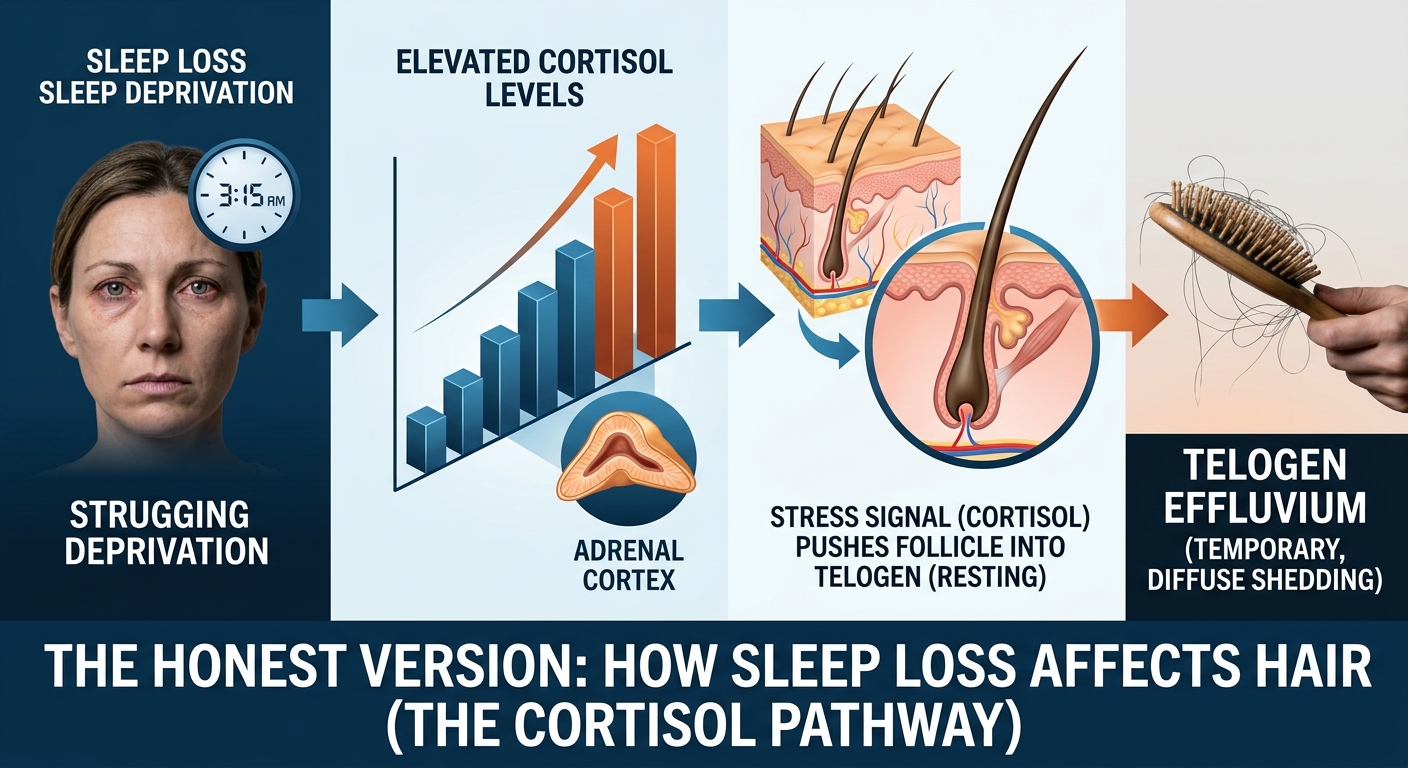
Right here’s the place the proof will get extra strong. Sleep restriction research have discovered that even partial sleep loss raises evening cortisol. Elevated cortisol is a acknowledged contributor to telogen effluvium, since it will possibly push follicles out of their development part prematurely. Chronic sleep deprivation and stress may deplete iron shops, and low ferritin is independently well-documented as a driver of telogen effluvium in its personal proper. That offers sleep two believable routes into the identical shedding sample: straight by cortisol, and not directly by iron depletion.
The reassuring half: telogen effluvium triggered this manner usually resolves inside six to 12 months as soon as the underlying stressor eases and sleep improves. That is basically completely different from genetic sample baldness, which doesn’t reverse simply because your sleep will get higher.
What About Sleep Apnea Particularly?
A cross-sectional research discovered an actual correlation between sleep apnea severity and hair loss in ladies. The researchers had been cautious to notice that extra analysis is required to ascertain causation, correlation alone doesn’t inform you which route the connection runs, or whether or not a 3rd issue explains each. Sleep apnea entails repeated drops in blood oxygen and real hormonal disruption, each believable mechanisms for affecting hair follicle operate, however this stays an space actively being studied slightly than settled.
Should you’ve observed hair shedding alongside a anxious, sleep-deprived stretch, book a consultation with The Sleep Consultant so we are able to take a look at what’s really driving it.
What the Analysis Exhibits
A 2025 systematic assessment discovered the sleep-hair loss connection actual however unproven as causal. Reviewers recognized real neuroendocrine and immune pathways linking sleep and hair well being, whereas stating straight that present analysis can not set up trigger and impact.
The favored “sleep raises DHT” declare isn’t backed by the analysis. DHT drives genetic sample baldness by a separate pathway tied to hormones and heredity, and no research traces sleep deprivation to elevated DHT ranges particularly.
Cortisol gives a extra believable, better-supported connection, particularly to telogen effluvium. Sleep restriction research present actual cortisol elevation, and elevated cortisol is a acknowledged set off for one of these short-term, diffuse shedding, distinct from genetic baldness.
Sleep-related hair shedding is usually reversible, in contrast to sample baldness. Telogen effluvium linked to a sleep-related stressor usually resolves inside six to 12 months as soon as sleep improves, a meaningfully completely different outlook than genetically pushed hair loss.
This text is for instructional functions solely and isn’t an alternative choice to personalised medical recommendation, analysis, or therapy.
Wish to Handle the Root Reason behind Your Stress and Sleep?
Be part of the free Sleep Nirvana Membership course and neighborhood for sensible, root-cause-first steering: Join here
When to Search Skilled Assist
- You’re noticing diffuse hair shedding that began two to a few months after a anxious or sleep-disrupted interval
- Your hair loss follows a sample (receding hairline, thinning crown) slightly than diffuse shedding, which factors towards a dermatologist analysis for androgenetic alopecia as an alternative
- You observed sleep apnea and have observed hair modifications alongside loud night breathing or daytime fatigue
- Hair shedding hasn’t improved after six to 12 months of higher sleep, price a dermatologist go to to test for different causes like iron deficiency or thyroid points
- You’re experiencing hair loss alongside different signs, since a number of underlying situations can current this manner
Often Requested Questions
Does lack of sleep really trigger hair loss?
The sincere reply is “presumably contributes, however not confirmed.” A 2025 systematic assessment discovered actual organic connections between sleep and hair well being however said plainly that present analysis can not show trigger and impact. Sleep deprivation seems extra prone to contribute to short-term shedding than to trigger genetic sample baldness.
Does poor sleep increase DHT ranges?
No research has proven this straight. DHT drives genetic sample baldness by a hormonal pathway tied to heredity, stay awake period. The declare that poor sleep raises DHT seems to be an assumption, not a measured discovering.
What’s the distinction between telogen effluvium and sample baldness?
Telogen effluvium is short-term, diffuse shedding triggered by a stressor like sickness, main stress, or presumably poor sleep, normally showing two to a few months after the set off and resolving inside six to 12 months. Sample baldness is a sluggish, progressive, genetically pushed course of tied to DHT, and it doesn’t reverse by itself.
Can fixing my sleep reverse hair loss?
It is dependent upon the trigger. If sleep-related stress contributed to short-term shedding (telogen effluvium), enhancing sleep and resolving the underlying stressor usually helps it resolve inside six to 12 months. In case your hair loss is genetic sample baldness, higher sleep received’t reverse it, since that course of runs by a separate hormonal pathway.
Is sleep apnea linked to hair loss?
A cross-sectional research discovered an actual correlation between sleep apnea severity and hair loss in ladies, although researchers famous extra work is required to ascertain whether or not one really causes the opposite. Should you suspect sleep apnea, it’s price a correct analysis whatever the hair connection.
When to Work With a Sleep Marketing consultant
The sleep-hair loss connection is actual sufficient to take critically, but it surely’s extra particular and extra restricted than most social media content material suggests. If stress and poor sleep are a part of your image, addressing them is price doing by itself deserves, hair included.
Trending Merchandise

COONP King Mattress Topper, Extra T...

CoolShields Waterproof Bed Pads Inc...

Nordic Elk Mattress Bags for Moving...

Waterproof Mattress Protector Twin ...

Utopia Bedding Waterproof Mattress ...

BEDLORE Waterproof Mattress Protect...

Queen Mattress Protector Waterproof...
