
You go to sleep shortly, then wake at 2:07 a.m. Your thoughts is alert, your physique feels drained, and the clock appears to maneuver sooner than you do. You attempt respiratory workout routines, test your telephone, calculate what number of hours stay earlier than the alarm, and ultimately spend the subsequent day performing on fragmented sleep. The sample repeats the next night time.
That sample wants a distinct response from bother falling asleep at bedtime. Sleep upkeep insomnia means you possibly can provoke sleep however wake in the course of the night time, stay awake for a chronic interval, or wake too early and might’t return to sleep. Probably the most dependable path ahead is sequenced, not random: establish the awakening sample, rebuild sleep strain with CBT-I, tune circadian and environmental inputs, examine medical drivers, then use measurements to regulate the plan.
Desk of Contents
Why You Preserve Waking at 2 a.m.
A shopper I am going to name Maya, a high-performing operations director, had no bother falling asleep. Her drawback started after the primary few sleep cycles. She woke at virtually the identical time, reached for her Oura ring, after which spent an extended stretch monitoring her wakefulness. The unique awakening was irritating. The checking, calculating, and worry of one other ruined day saved the episode going.
That distinction issues. Transient arousals are a part of regular sleep, however sleep upkeep insomnia turns into clinically vital when awakenings are frequent, extended, and adopted by issue resuming sleep. In a big U.S. examine of 8,937 adults, 35.5% reported waking no less than three nights per week, and 43% of these folks additionally had issue returning to sleep. That represented 15.2% of the overall pattern. The identical analysis discovered that greater than 80% of individuals with insomnia signs additionally skilled nocturnal awakenings. The medical examine on nocturnal awakenings and insomnia signs helps clarify why an individual could go to sleep usually but nonetheless have a big insomnia sample.
The awakening is a clue
The timing and expertise of the awakening can level towards completely different drivers:
- Circadian timing: An early shift within the physique clock could make the latter a part of the night time biologically lighter and convey alertness ahead.
- Physiological disruption: Sleep apnea, ache, reflux, temperature adjustments, treatment results, and different bodily alerts can set off repeated arousals.
- Metabolic or hormonal considerations: Some folks discover awakenings alongside starvation, sweating, palpitations, or different signs that deserve medical assessment fairly than a complement.
- Conditioned alertness: After sufficient tough nights, the mattress can develop into related to monitoring, frustration, and problem-solving. The mind then learns to remain vigilant on the acquainted wake window.
An awakening at 2 a.m. does not show one trigger. It offers you a place to begin for testing the sample. Waking as soon as and returning to sleep shortly is completely different from waking repeatedly, remaining alert for an extended interval, and feeling impaired the subsequent day.
If you’d like a centered clarification of the early-morning sample, this information to why you wake up at 3 a.m. is a helpful companion. The sensible level is easy: do not deal with each middle-of-the-night awakening as a bedtime drawback. First decide whether or not the problem is sleep strain, circadian timing, an exterior disturbance, a medical situation, or discovered arousal.
Assess Your Awakenings Earlier than Altering Something
Do not begin by shopping for a brand new sleep support. Begin by accumulating a clear image of the night time. Reminiscence is very unreliable after a fragmented night time, and obscure impressions make it straightforward responsible the mistaken variable.
Construct an awakening profile
Use a paper diary or notes app for a constant baseline interval. Report:
- Lights-out time: While you received into mattress, not whenever you assume you fell asleep.
- Sleep latency: Your estimate of how lengthy it took to go to sleep.
- Awakening timing: The approximate time of each awakening.
- Wake period: Whether or not you returned to sleep shortly or stayed awake for a chronic interval.
- Morning operate: Fee freshness, vitality, focus, and temper on a easy private scale.
- Potential triggers: Notice caffeine, alcohol, train, late meals, reflux, ache, temperature, and medicine timing.
The purpose is not excellent precision. It is sample recognition. Awakenings clustered in a single window recommend a distinct line of inquiry from awakenings scattered all through the night time. Repeated awakenings accompanied by loud night breathing, gasping, dry mouth, morning complications, or witnessed respiratory pauses ought to transfer sleep apnea screening forward of routine sleep optimization. Ache, reflux, stressed legs, night time sweats, and frequent urination additionally deserve consideration.
Display screen the pink flags
Ebook a clinician analysis when you suspect apnea, really feel dangerously sleepy in the course of the day, or end up falling asleep whereas driving. Search immediate skilled assist for extreme temper signs, uncommon nighttime confusion, respiratory issue, chest signs, or ideas of self-harm.
Evaluation treatment timing with a prescriber fairly than altering it independently. Antidepressants, decongestants, stimulants, corticosteroids, and short-acting sleep medicines can have an effect on sleep in a different way from individual to individual. Your clinician can also determine whether or not thyroid, iron, or different testing is acceptable.
For a extra formal framework, the 2026 clinical diagnostic criteria may also help you perceive why frequency, period, daytime impairment, and exclusion of different causes matter in a reputable evaluation.
Awakening Sample Decoder
| Sample | Probably Driver | First Transfer |
|---|---|---|
| One predictable awakening with speedy return to sleep | Regular arousal or a light environmental set off | Verify noise, mild, temperature, and fluid timing |
| One predictable awakening adopted by extended alertness | Circadian timing or conditioned arousal | Preserve a set wake time and start CBT-I rules |
| Repeated awakenings with loud night breathing or gasping | Potential sleep-disordered respiratory | Organize medical screening earlier than self-treatment |
| Awakenings with ache, reflux, sweating, or palpitations | Medical or physiological set off | Report the symptom and focus on it with a clinician |
| Restlessness or an urge to maneuver the legs | Potential stressed legs overlap | Request a medical assessment and contemplate iron analysis |
The output ought to be a one-page abstract: whenever you wake, how lengthy you keep awake, what you’re feeling, and what occurred earlier than mattress. That profile is extra helpful than a generic label resembling “unhealthy sleeper.”
Construct the Behavioral Basis with CBT-I
Cognitive behavioral remedy for insomnia, or CBT-I, is the muse for power sleep upkeep insomnia. It does not sedate the mind. It rebuilds the connection between mattress and sleep, strengthens sleep strain, reduces anticipatory fear, and teaches you what to do throughout an awakening.
A serious assessment masking 241 randomized managed trials and 31,452 adults discovered moderate-to-large results on insomnia signs and key sleep measures. One other proof assessment reported enhancements in sleep latency of 30 to 45 minutes, complete sleep time of 30 to 60 minutes, and sleep effectivity of 8% to 16% after CBT-I. These figures come from the review of CBT-I evidence and clinical guidance. The American School of Physicians recommends CBT-I because the preliminary therapy for power insomnia dysfunction.
Rebuild sleep strain
Sleep restriction or sleep compression briefly matches time in mattress extra carefully to the quantity of sleep you’re getting. In the event you spend an extended night time in mattress however stay awake for a considerable interval, extending bedtime could make the issue worse. A fastidiously constructed schedule will increase the organic want for sleep and helps consolidate the night time.
This is not a method to improvise aggressively. Sleep restriction can improve daytime sleepiness at first, significantly in case your present sleep is already quick. A clinician skilled in CBT-I ought to assist set the beginning schedule, monitor a sleep diary, and broaden time in mattress step by step as sleep turns into extra consolidated.
Break the mattress and wakefulness hyperlink
Stimulus management is usually probably the most instantly useful gizmo for the two a.m. awakening. Go to mattress whenever you’re sleepy, reserve the mattress for sleep and intercourse, and get off the bed whenever you’ve been awake for roughly 10 to twenty minutes. Return solely when sleepiness comes again, utilizing dim mild and a quiet exercise that does not invite work, scrolling, or emotional stimulation. Sleep Foundation’s treatment guidance describes stimulus management and sleep restriction as core parts of first-line insomnia therapy.
Do not flip the time off the bed right into a efficiency check. The target is to cease rehearsing wakefulness in mattress, to not drive sleep on a strict timetable.
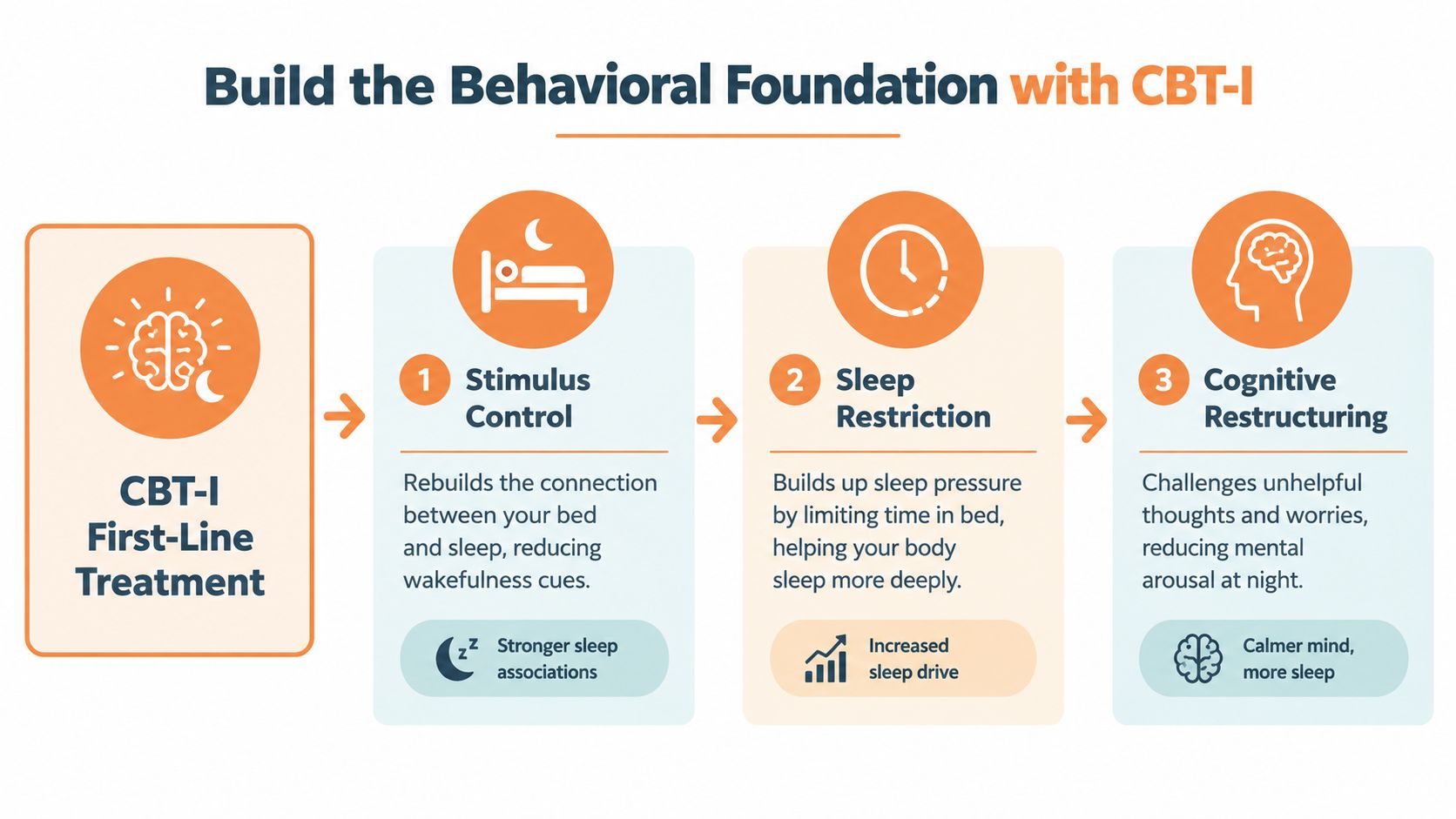
Cognitive restructuring handles the ideas that amplify the awakening: “Tomorrow is ruined,” “I must sleep now,” or “This may by no means enhance.” Exchange catastrophic forecasting with a sensible response: the awakening is uncomfortable, however the subsequent motion is already determined. Put the plan into follow persistently fairly than negotiating with your self at 2 a.m.
CBT-I works for many individuals, but it surely is not common. One medical abstract studies that seven to eight out of ten folks enhance meaningfully, whereas one other assessment notes that roughly 19% to 26% could not reply and solely about one-third attain full remission. Cleveland Clinic’s CBT-I overview additionally highlights the necessity for monitoring and gradual adjustment. Advantages can stay sturdy, with one medical primer describing upkeep for as much as 24 months.
If you’d like a extra detailed clarification of the method, see this information to CBT-I for insomnia. Medicine can typically help an acute interval or a tough CBT-I begin, but it surely should not exchange the behavioral work that addresses the upkeep loop.
Tune Your Circadian and Atmosphere
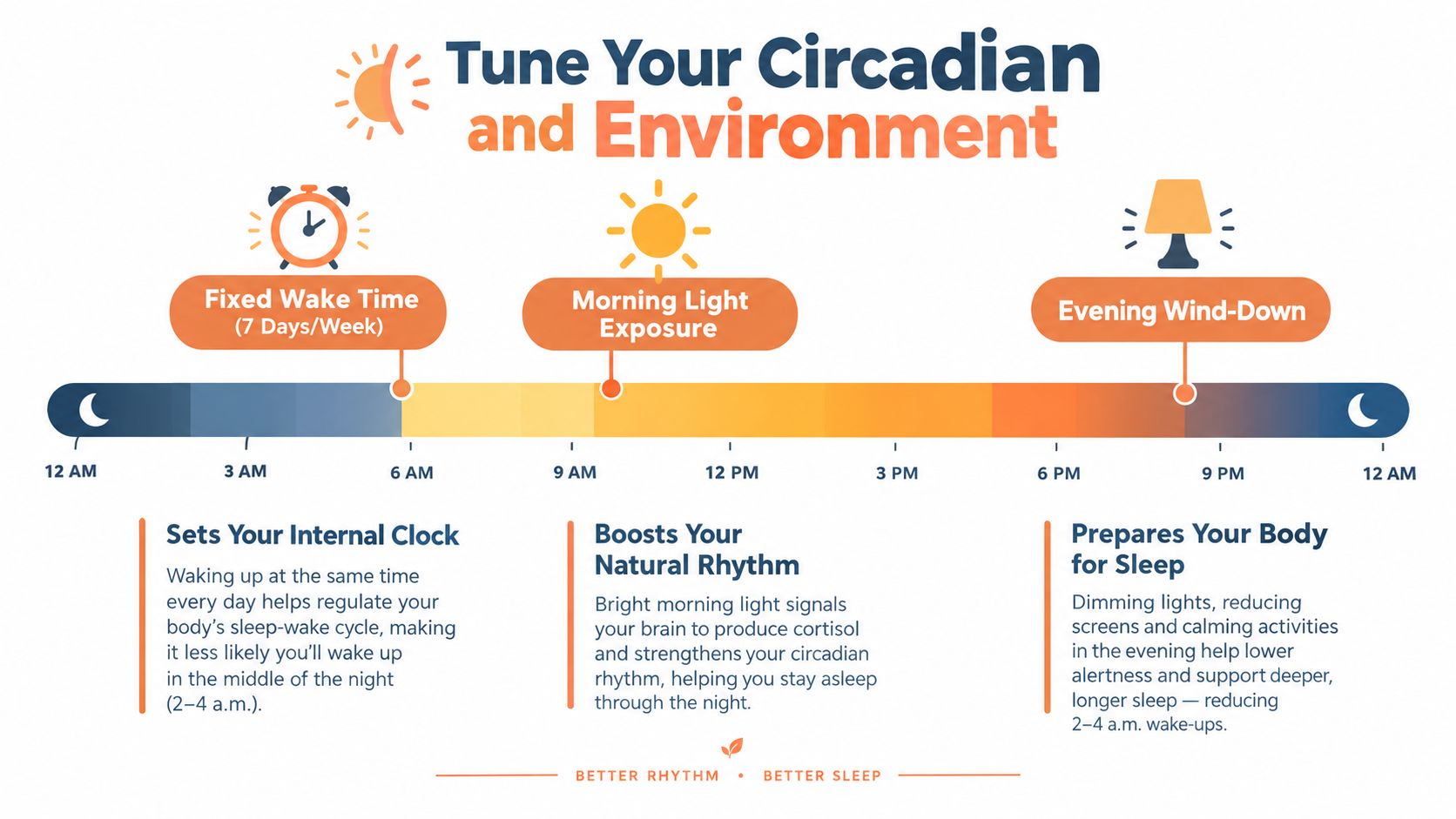
As soon as the behavioral basis is in place, make your schedule simpler for the physique clock to comply with. Crucial anchor is a mounted wake time each day, together with weekends and mornings after a poor night time. A secure wake time offers your circadian system a constant reference level and prevents late rising from decreasing sleep strain the next night.
Get out of doors mild quickly after waking when attainable. Morning mild tells the mind that the day has began and may also help align the sleep-wake rhythm. If out of doors mild is not sensible, a clinically acceptable bright-light gadget could also be thought-about, however folks with eye circumstances, mild sensitivity, or sure psychiatric circumstances ought to ask a clinician earlier than utilizing one.
Take away predictable night time disruptors
Your night atmosphere ought to make continued sleep simpler, not merely enable you to go to sleep. Dim family lighting because the night progresses, hold screens from changing into the ultimate exercise earlier than mattress, and make the bed room cool, darkish, and quiet. Use blackout curtains, earplugs, or regular background sound when exterior mild or noise repeatedly triggers awakenings.
Alcohol deserves an sincere trial of removing. It could make sleep onset really feel simpler whereas fragmenting sleep later within the night time, which is precisely when many maintenance-insomnia episodes seem. In the event you drink, file the timing and quantity in your diary fairly than assuming it has no impact.
Late meals may matter, particularly when reflux accompanies the awakening. End massive meals effectively earlier than mattress and hold the night meal less complicated if digestion seems to be a part of the sample. Do not add a bedtime snack mechanically to “stabilize” sleep. Check meals timing towards your precise symptom profile.
Temperature adjustments will be surprisingly disruptive. Select breathable bedding, deal with overheating earlier than mattress, and hold the room comfy all through the night time. In the event you wake sizzling, sweaty, congested, or wanting breath, deal with that symptom as data. A cooler room will not repair apnea, reflux, treatment results, or power stress, however it could take away one avoidable set off.
Drugs, Dietary supplements, and Biomarker Testing
Medicine, dietary supplements, and testing can have a spot, however they belong after a transparent evaluation fairly than on the entrance of the queue. The frequent mistake is utilizing a sedating product to suppress awakenings whereas leaving the trigger, timing, and conditioned arousal untouched.
Prescription choices could assist throughout an acute disaster or as a brief bridge whereas CBT-I begins. Z-drugs, low-dose doxepin, and twin orexin receptor antagonists resembling suvorexant have completely different mechanisms and threat profiles, so a prescriber wants to contemplate next-day impairment, interactions, tolerance, dependence threat, age, medical circumstances, and the potential for sleep apnea. Do not mix sedating merchandise or change a prescription with out medical steering.
A complement will be cheap when it addresses an outlined want and you may choose its impact. Magnesium glycinate, L-theanine, or apigenin could also be thought-about as adjuncts for some folks with residual arousal, however “low threat” does not imply risk-free. Product high quality, interactions, gastrointestinal results, and particular person sensitivity nonetheless matter. Melatonin is not a common answer for power upkeep insomnia, and escalating the dose can create a false sense that extra is best.
Use testing to reply a query
Biomarker testing earns consideration when a well-executed behavioral plan stalls or when signs recommend a physiological contributor. Relying on the presentation, a clinician may contemplate iron research for restless-legs signs, thyroid testing, inflammatory markers, or analysis of the cortisol rhythm. A salivary or dried-urine cortisol panel could generate hypotheses, but it surely should not be handled as a definitive clarification for each 2 a.m. awakening.
Testing ought to rule in or rule out believable contributors. It should not develop into an infinite seek for an optimization goal whilst you ignore wake-time consistency, stimulus management, alcohol, treatment timing, or apnea screening.
Intervention Determination Desk
| State of affairs | First-line | Adjunct | Skip |
|---|---|---|---|
| You keep awake after predictable nighttime awakenings | CBT-I, stimulus management, and a constant wake anchor | Clinician-guided treatment if impairment is extreme | Randomly including a number of sleep merchandise |
| You snore, gasp, or wake with respiratory signs | Medical analysis for sleep-disordered respiratory | Sleep examine or therapy advisable by a clinician | Treating the symptom solely with sedatives |
| You’ve gotten stressed legs or uncommon leg sensations | Medical assessment and acceptable iron evaluation | Focused therapy if a deficiency or dysfunction is recognized | Excessive-dose dietary supplements with out testing |
| You wake with reflux, ache, sweating, or palpitations | Analysis of the underlying symptom | Environmental and meal-timing changes | Assuming the awakening is only psychological |
| Behavioral progress has stalled regardless of constant follow | Evaluation the diary and protocol with a skilled skilled | Centered biomarker testing when clinically justified | Broad testing with no choice it would inform |
In the event you’re contemplating treatment, use a clinically reviewed useful resource resembling this sleeping pills guide to organize questions to your prescriber. The precise selection relies on the person sample, not on which product sounds strongest.
Observe, Iterate, and Alter Over 4 to Six Weeks
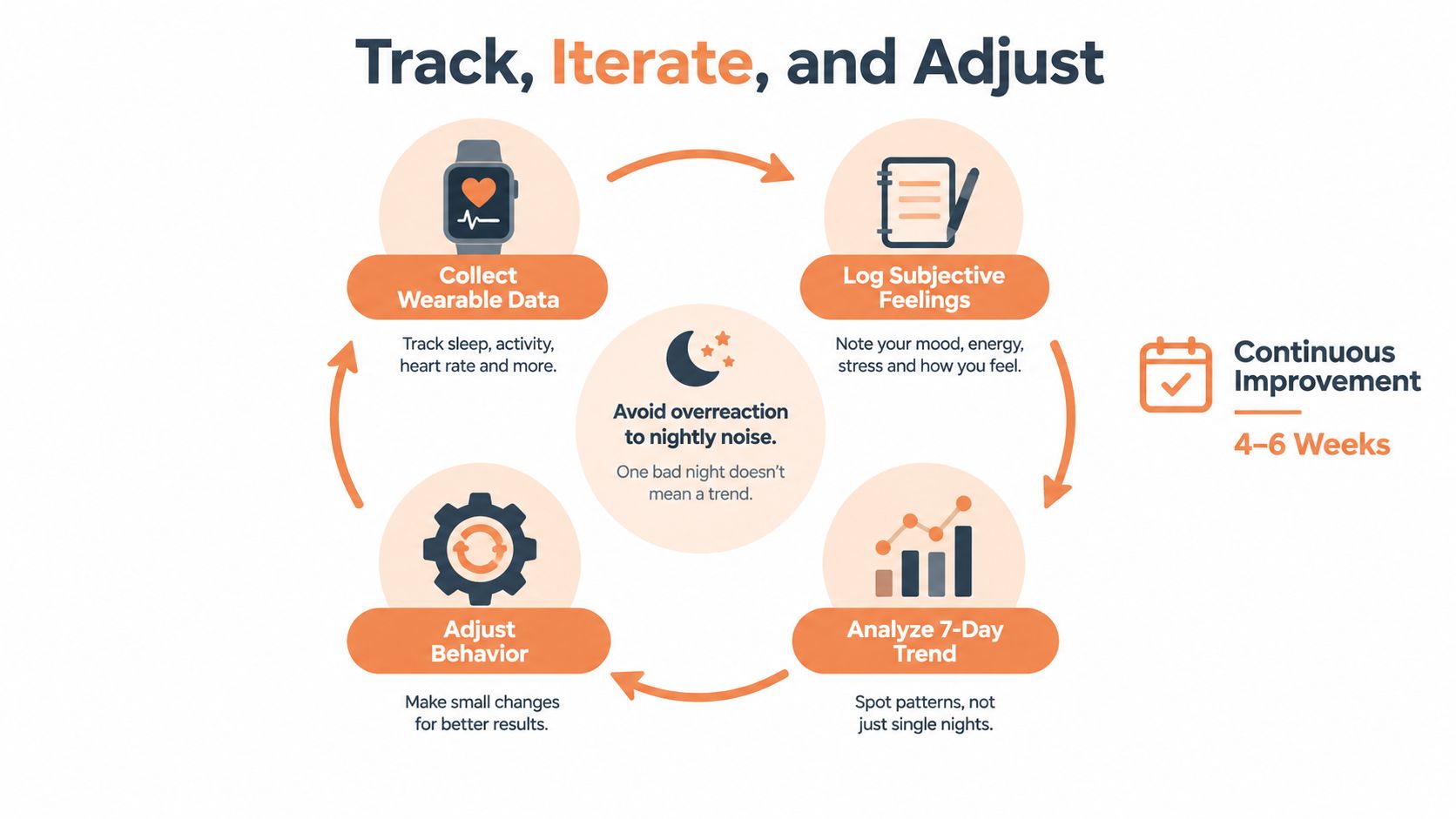
Wearables may also help, however they will additionally flip sleep right into a nightly scorecard. Use an Oura Ring, WHOOP, Apple Watch, or one other gadget as a sample detector, not a verdict. Shopper gadgets estimate sleep and wake states, and their readings will be particularly unsure throughout quiet wakefulness. If the gadget says you slept whilst you bear in mind studying the ceiling, file each items of data.
Construct a relaxed suggestions loop
Start with a baseline. Log bedtime, estimated sleep latency, awakening instances, wake period, ultimate wake time, and morning operate whereas preserving adjustments minimal. Then introduce one behavioral adjustment and one circadian or environmental adjustment at a time. In the event you change your wake time, add magnesium, cease alcohol, transfer dinner, and purchase a brand new wearable in the identical week, you will not know what helped.
Evaluation the rolling seven-day pattern in wake after sleep onset fairly than reacting to 1 tough night time. Examine the gadget estimate along with your diary and with the way you functioned. A decrease wake estimate paired with worse daytime focus is not mechanically progress.
Sensible rule: Change one main variable, observe the pattern, and maintain the remainder of the protocol regular.
If the pattern improves, hold the routine secure as an alternative of rewarding progress with a later bedtime. If it stays flat, revisit the awakening profile and exchange one variable fairly than abandoning all the plan. If it worsens alongside harmful sleepiness, respiratory signs, temper adjustments, or bodily complaints, escalate to a clinician fairly than intensifying sleep restriction by yourself.
Rising insomnia analysis can also be paying nearer consideration to wake after sleep onset. The Sleep Advances discussion of insomnia measurement describes why older actigraphy can miss this vital metric and why combining motion knowledge with photoplethysmography could supply extra helpful monitoring. That does not make a wearable diagnostic. It makes cautious interpretation extra vital.
Your Beginning Level and What to Do Tonight
The best-value transfer tonight is easy: set a wake time you possibly can keep each day and open a sleep diary. Report lights-out, estimated time to go to sleep, every awakening, approximate time awake, ultimate wake time, and the way you’re feeling within the morning. Do not flip the diary right into a check of whether or not you slept completely. Its job is to disclose the sample that your drained mind retains blurring.
Maintain off on constructing a complement stack in the course of the baseline. With out figuring out whenever you wake, how lengthy you keep awake, and what occurs earlier than mattress, you possibly can’t inform whether or not a product helped, distracted you, or merely modified your expectations. A wearable is non-obligatory. Use one provided that you possibly can assessment developments calmly and keep away from treating a single rating as a prognosis.
Begin CBT-I rules fairly than accumulating generic sleep-hygiene suggestions. Preserve the wake time mounted, go to mattress when sleepy, and go away the mattress throughout a chronic awakening. If the sample persists, ask a clinician about CBT-I and display for apnea, ache, reflux, stressed legs, treatment results, and different medical drivers. For extra behavioral concepts, this useful resource on treat insomnia naturally can complement, however should not exchange, a correct evaluation.
Tonight, set the alarm, dim the night atmosphere, put the telephone out of attain, and write down what occurs. A documented sample offers you one thing actionable. Chasing one other sleep support does not.
The Sleep Advisor presents individualized sleep protocols that mix routine design, circadian timing, biomarker assessment, supplementation steering, and ongoing measurement for high-performing professionals with persistent awakenings. Go to The Sleep Consultant to request a sleep evaluation and switch your awakening diary right into a sensible plan.
Trending Merchandise

COONP King Mattress Topper, Extra T...

CoolShields Waterproof Bed Pads Inc...

Nordic Elk Mattress Bags for Moving...

Waterproof Mattress Protector Twin ...

Utopia Bedding Waterproof Mattress ...

BEDLORE Waterproof Mattress Protect...

Queen Mattress Protector Waterproof...
