
You are answering emails at 3 AM as a result of sleep has grow to be the one assembly you possibly can’t management. Your physique is exhausted, your thoughts is replaying conversations and selections, and the following day nonetheless comprises a board assembly, a workforce that wants route, and selections that do not really feel protected to postpone. After a major loss, this is not proof that you simply’re failing at resilience. It is a predictable collision between grief, risk physiology, disrupted routines, and the organic circumstances required for sleep.
Grief and insomnia deserve greater than generic recommendation to “loosen up.” A serious systematic review of bereavement and sleep examined 85 research involving 12,294 contributors and located robust proof connecting bereavement with poorer sleep high quality, problem falling asleep, shorter sleep, and anxious awakenings. The sensible query is easy methods to determine the mechanism affecting you, then apply a restoration protocol that protects each your well being and your management capability.
Desk of Contents
The Hidden Toll of Bereavement on Govt Efficiency
At 3 AM, a grieving government could look useful on paper. The calendar is full, the corporate is shifting, and the individual continues to be making selections. Internally, nonetheless, the evening has grow to be a negotiation. Sleep arrives in fragments, the mattress feels unsafe or unfamiliar, and each quiet interval creates room for recollections, remorse, logistics, or concern.
A founder would possibly spend the day dealing with pressing work and household tasks, then uncover that the distractions disappear at evening. A CEO who usually falls asleep shortly could lie awake reviewing the ultimate days of somebody’s life. One other chief could wake early with a racing coronary heart and start working as a result of returning to mattress feels unimaginable. These reactions aren’t character flaws. They’re frequent expressions of a system that hasn’t but recalibrated after loss.
Sensible rule: Deal with sleep disruption after bereavement as a well being sign, not a efficiency failure.
Why willpower stops working
Excessive performers typically reply to grief by growing management. They work longer, journey anyway, compress meals, and use late-night productiveness to keep away from emotional publicity. That technique can protect output briefly, nevertheless it removes the common cues that assist regulate sleep, together with constant wake time, daylight publicity, motion, and predictable decompression.
The physiological downside is simply as necessary. Bereavement can go away the nervous system in a state of heightened vigilance. Deep sleep requires a discount in arousal, whereas grief can hold the mind scanning for which means, hazard, unfinished duties, and reminders of the loss. The result’s an exhausted physique paired with a mind that refuses to face down.
Customary sleep hygiene should still assist, nevertheless it not often solves the entire downside. Blackout curtains cannot resolve intrusive recollections, and a cooler room will not by itself appropriate a concern response related to bedtime. Essentially the most helpful place to begin is to cease asking, “Why cannot I make myself sleep?” and ask, “Which organic and behavioral methods are stopping sleep from consolidating?”
The manager value
Sleep disruption impacts greater than vitality. It might probably slender consideration, improve emotional reactivity, and make complicated selections really feel disproportionately tough. Throughout bereavement, that issues as a result of leaders could also be managing succession questions, household tasks, authorized administration, or modifications within the group whereas their cognitive reserve is already lowered.
A sensible assessment of sleep and mental health may also help place insomnia in a wider scientific context. In case your sleep loss is affecting judgment, driving, security, or your capability to handle fundamental tasks, contain a doctor or certified psychological well being skilled reasonably than making an attempt to compensate with stimulants and longer workdays.
How Grief Rewires the Mind and Disrupts Sleep Structure
Grief modifications the circumstances below which sleep should happen. The hypothalamic-pituitary-adrenal axis, or HPA axis, coordinates the stress response. After a serious loss, stress signaling can stay energetic when the physique needs to be shifting towards decrease arousal. Cortisol and adrenaline are helpful throughout instant risk, however their continued activation can intervene with sleep onset and upkeep.
The cascade behind a sleepless evening
The cascade normally has a number of interacting parts:
- HPA axis activation: Stress indicators stay extra outstanding, making it more durable to transition from alertness into sleep.
- Sympathetic overdrive: A sooner pulse, muscle stress, and heightened startle response oppose the parasympathetic state related to relaxation.
- Cognitive arousal: Rumination retains consideration engaged with recollections, counterfactuals, and unresolved sensible questions.
- Circadian disruption: Loss can change meals, gentle publicity, social contact, train, and wake occasions, weakening the cues that arrange sleep.
- Sleep fragmentation: Repeated awakenings cut back the continuity wanted for restorative sleep and emotional processing.
Cortisol is not the one related sign. The mind additionally responds to the which means of the loss, the circumstances surrounding it, and the absence of acquainted security cues. If a companion used to offer heat, motion, or a shared bedtime rhythm, the empty facet of the mattress can grow to be a robust reminder that the setting has modified.
Rumination creates a second barrier. In the course of the day, conferences and duties can suppress grief-related ideas quickly. At evening, lowered stimulation permits these ideas to return with larger pressure. Making an attempt to pressure them away typically will increase arousal, as a result of the mind interprets suppression as proof that the thought requires monitoring.
Sleep structure and emotional processing
Sleep is not one uniform state. Deep sleep helps bodily restoration, whereas REM sleep contributes to emotional processing and reminiscence integration. Grief can fragment the transitions between levels, so an individual could spend sufficient time in mattress with out receiving sufficient consolidated sleep.
That distinction issues for executives who depend on wearable scores. A tool could estimate sleep levels, however it might’t decide whether or not an awakening adopted a reminiscence, a nightmare, alcohol, temperature change, or respiration disturbance. Wearables are helpful for traits, not prognosis. Pair their information with a sleep diary and scientific evaluation.
For a extra detailed dialogue of trauma-related arousal and sleep disruption, how trauma and sleep intersect offers helpful context. You can even discover what the brain learns from grief while you need a psychologically grounded clarification of how loss reshapes expectations, reminders, and emotional responses.
Grief does not merely add disappointment to an in any other case regular evening. It might probably change the alertness, timing, and associations that make sleep doable.
The bidirectional relationship is clinically necessary. The 2020 systematic review discovered a excessive prevalence of sleep issues, a constant constructive affiliation between grief depth and sleep problem, and preliminary proof that difficult grief and sleep disturbance can reinforce one another. Grief remedy could enhance sleep partly, however sleep-specific therapy stays an necessary hole.
Figuring out Persistent Insomnia Trajectories After a Loss
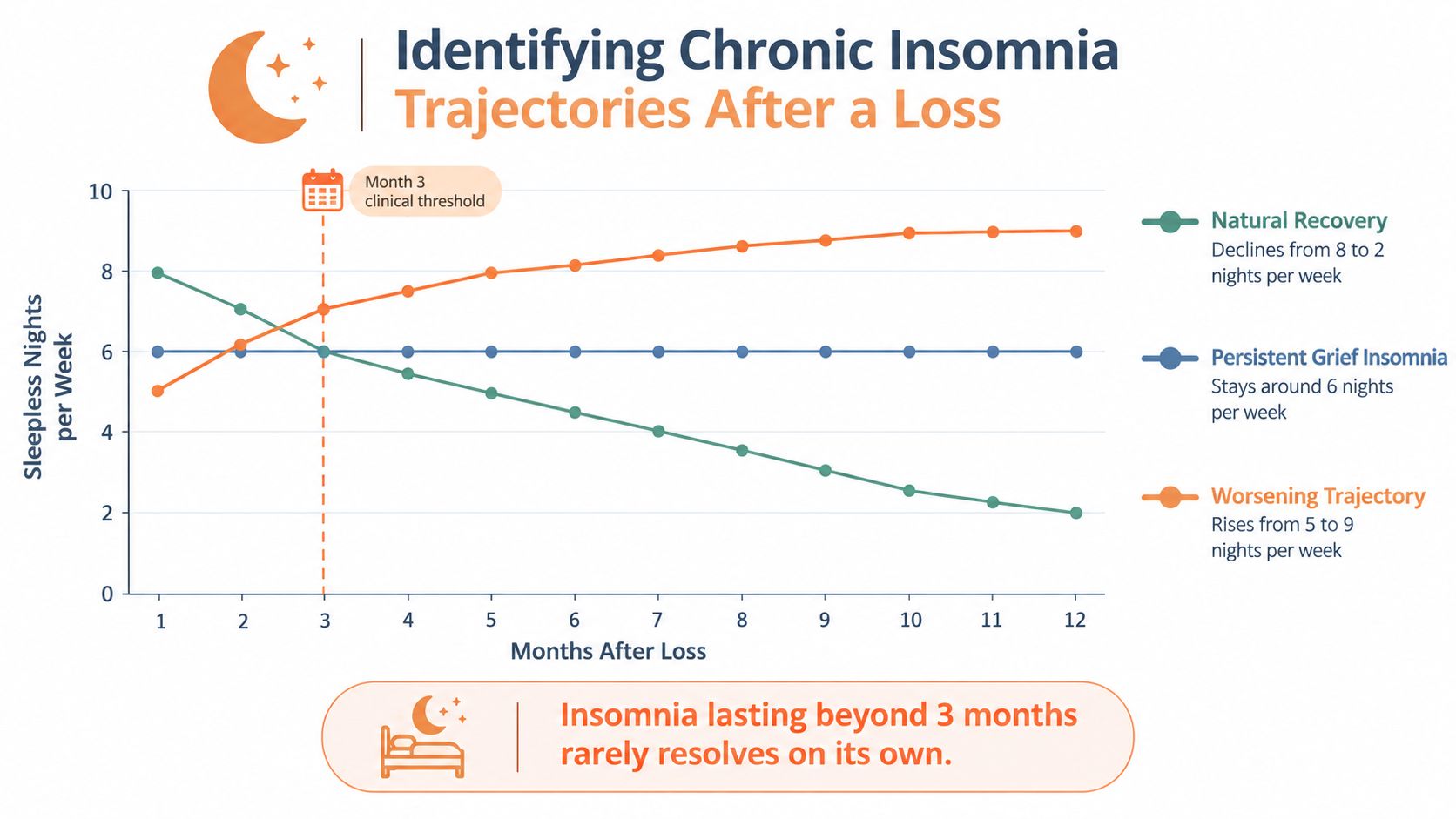
Not each tough evening indicators a continual dysfunction, however assuming that every one grief-related insomnia will resolve with out help can also be a mistake. Sleep can enhance as acute shock settles, or it might grow to be conditioned round vigilance, rumination, and dread of bedtime. The distinction is normally seen within the trajectory reasonably than in a single remoted evening.
A 2024 bereavement trajectory research recognized three patterns. Forty-seven % adopted a resilient course, 43% adopted a recovering course, and 10% developed a continual insomnia trajectory, as reported within the study dataset from the University of Groningen. Baseline melancholy predicted the continual sample, and at one 12 months, possible extended grief dysfunction appeared in 60% of the continual group in contrast with 9% of the resilient group, in response to the identical supply.
What separates restoration from persistence
Essentially the most helpful distinction is just not whether or not you sleep badly instantly after a dying. Acute disruption is comprehensible. The extra informative query is whether or not sleep begins to regain construction, even inconsistently, or whether or not the sample stays mounted or worsens.
Look ahead to:
- Persistent night-to-night impairment: Sleep stays poor with out significant motion towards consolidation.
- Bedtime conditioning: You start to anticipate one other failed evening earlier than entering into mattress.
- Daytime compensation: Lengthy naps, late waking, extreme caffeine, or working in mattress hold the cycle energetic.
- Rumination dominance: The identical ideas return repeatedly with out producing decision.
- Temper deterioration: Melancholy, hopelessness, panic, or withdrawal intensify alongside insomnia.
Sleep issues are particularly concentrated in extended or difficult grief. A assessment reported that extended grief dysfunction impacts roughly 3% to five% of bereaved people and might be about 5 occasions larger after sudden or violent deaths, whereas one other complicated-grief pattern discovered 91% baseline sleep disturbance and 46% reporting grief-related sleep bother not less than 3 times per week, as summarized within the clinical review of grief and sleep.
Use a threshold for motion, not a deadline for grief
A scientific threshold should not be handled as a deadline for emotional restoration. It is a immediate to evaluate whether or not insomnia has grow to be self-sustaining. If you happen to’re unable to perform, utilizing alcohol or medicine with out supervision, or experiencing ideas of self-harm, search instant skilled help no matter how lengthy it has been.
A basic information to common causes of insomnia may also help you distinguish grief-related triggers from contributors resembling ache, medicine results, environmental disturbance, or irregular scheduling. The prognosis nonetheless belongs with a certified clinician, particularly when loud night breathing, gasping, stressed legs, or extreme daytime sleepiness suggests one other sleep problem.
A separate bereavement cohort discovered 47% resilient, 43% recovering, and 10% continual insomnia trajectories, whereas daily-diary and ecological momentary evaluation findings linked poorer sleep with larger next-day grief severity. These findings help an necessary working precept: intervene when the sample is persistent, not solely after it has broken efficiency for months.
Diagnostic Testing and Biomarker Evaluation for Grieving Leaders
Measurement can cut back guesswork, nevertheless it have to be used intelligently. Grief is just not a single biomarker abnormality, and no laboratory panel can quantify love, loss, or readiness to heal. Testing is most helpful when it identifies medical contributors that may amplify insomnia and when the outcomes change the intervention.
A clinician could start with an in depth historical past masking the loss, sleep timing, awakenings, medicines, alcohol, caffeine, journey, ache, temper, loud night breathing, and modifications in every day routine. That historical past determines whether or not superior testing is acceptable and whether or not referral to a sleep doctor or psychological well being skilled ought to occur first.

A sensible diagnostic sequence
First, rule out pressing scientific issues. Extreme melancholy, suicidal ideas, mania, medicine interactions, untreated ache, respiration disturbances, and substance dependence require medical consideration. Sleep optimization ought to by no means delay look after a severe situation.
Subsequent, characterize the sample. Document bedtime, estimated sleep onset, awakenings, last waking, naps, caffeine, alcohol, train, and the emotional context of every awakening. Notice whether or not you wake sizzling, alert, panicked, bodily uncomfortable, or mentally preoccupied. These particulars typically level towards completely different interventions.
Then, consider related physiology. Relying on the individual’s signs and medical historical past, a clinician could assess thyroid perform, glucose regulation, iron standing, nutrient deficiencies, inflammatory burden, and hormone patterns. Cortisol timing might be informative in chosen circumstances, however a single measurement not often explains a whole sleep downside. Melatonin testing additionally requires cautious interpretation as a result of timing, gentle publicity, and assortment circumstances have an effect on outcomes.
Lastly, mix laboratory information with conduct and wearable traits. A wearable can present whether or not awakenings, resting coronary heart price, HRV, or estimated sleep timing modifications after a protocol adjustment. It can’t verify that grief precipitated a specific hormonal outcome, and it should not substitute scientific analysis.
What biomarker-led care can and might’t do
A broad panel of 2,200+ biomarkers could reveal physiological stressors or dietary deficits that deserve consideration, however extra information is not routinely higher. Testing can create nervousness, false precision, or pointless supplementation when outcomes aren’t interpreted in context.
The strongest use of testing is prioritization. If a outcome identifies a believable, treatable bottleneck, deal with it with a clinician, then observe whether or not signs and goal traits change. If nothing modifications, revise the speculation reasonably than including extra merchandise.
Measurement precept: A take a look at earns its place when it modifications the choice you make subsequent.
Be cautious with direct-to-consumer claims about neurotransmitter metabolites, cortisol “imbalances,” or irritation scores. Grief can have an effect on many methods, however a lab outcome does not set up causation. A professional medical skilled ought to interpret irregular findings, particularly while you’re contemplating thyroid medicine, hormone remedy, sedatives, or high-dose dietary supplements.
Behavioral and Environmental Interventions for Excessive Performers
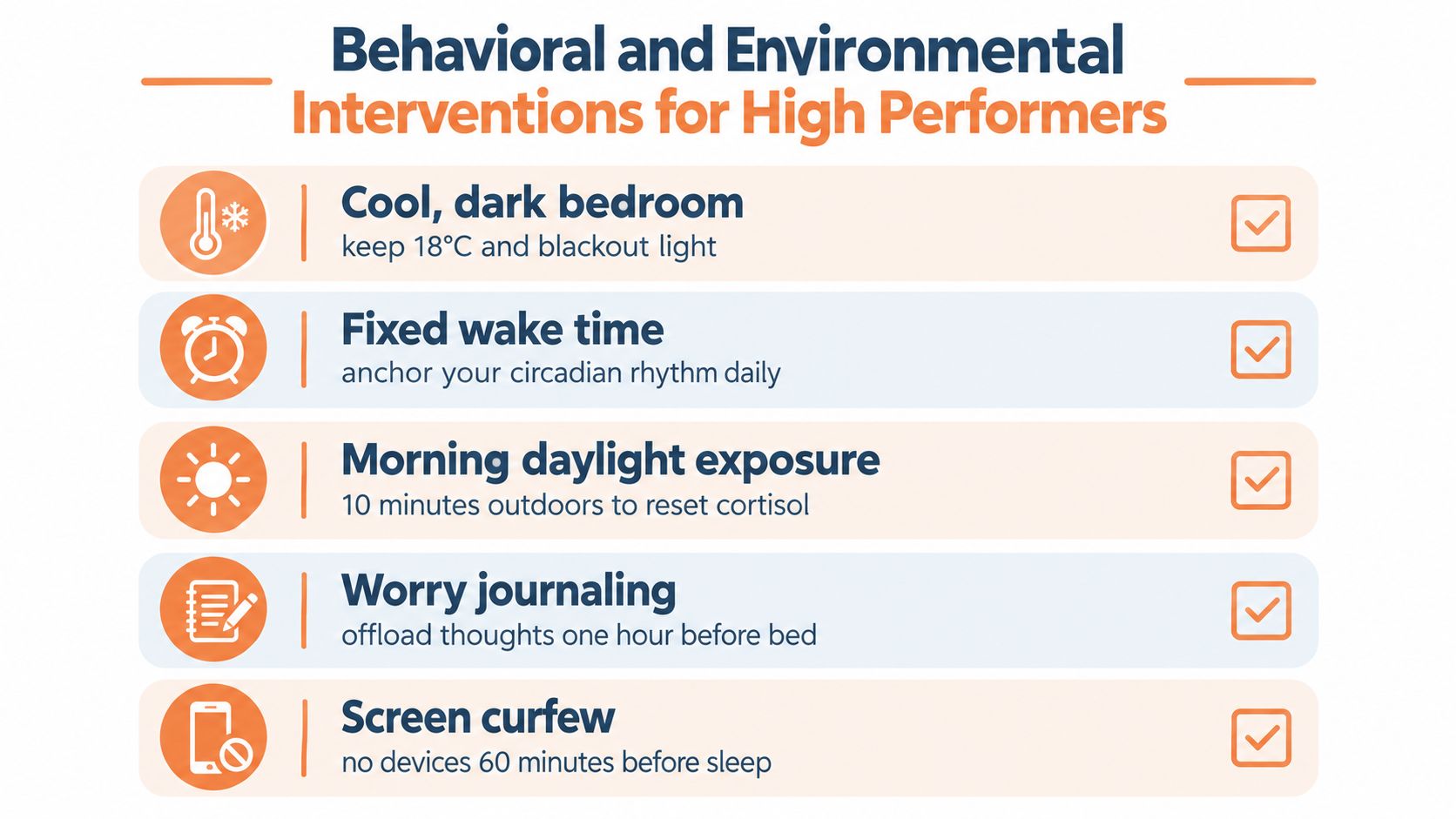
The best behavioral plan is normally much less glamorous than a biohacking stack. It creates repeated indicators of security and timing whereas lowering the habits that hold the nervous system activated. For an government, the problem is designing a protocol that survives late calls, journey, irregular meals, and emotionally tough evenings.
Anchor the morning earlier than optimizing the evening
A hard and fast wake time is commonly extra sensible than forcing an early bedtime. Select a wake time you possibly can preserve throughout workdays and most journey days, then expose your self to out of doors gentle quickly afterward. Morning gentle helps reinforce circadian timing, whereas motion and a predictable first meal present extra time cues.
The protocol might be easy:
- Wake persistently: Hold the morning anchor secure, even after a poor evening.
- Go outdoor: Get pure daylight early reasonably than relying solely on workplace lighting.
- Transfer gently: Use strolling or gentle mobility when intense coaching would add stress.
- Delay main selections: If sleep was severely fragmented, delegate irreversible selections the place doable.
Do not reply to a nasty evening by sleeping late, taking a protracted afternoon nap, and going to mattress a lot later. Which will present short-term aid whereas weakening the following sleep alternative.
Construct a decompression runway
Executives typically anticipate the nervous system to maneuver from a tough name straight into sleep. Give it a transition as an alternative. Finish work with a brief written shutdown: listing unresolved duties, assign every a subsequent motion, and determine what can wait. This is not emotional processing, nevertheless it prevents the mind from treating unfinished work as a nocturnal emergency.
Use a wind-down routine that may scale. On a traditional night, it’d embrace a bathe, dim lighting, light stretching, and studying. On a journey day, it could be a five-minute shutdown word, a watch masks, and quiet inhaling a lodge room. Consistency of sequence issues greater than perfection.
Engineer the room
A cool, darkish, quiet room can decrease sensory load, however grief could require extra environmental experimentation. Some individuals sleep higher after altering the mattress association, utilizing a physique pillow, including acquainted texture, or shifting quickly to a different room. The intention is not to erase the connection or keep away from recollections without end. It is to cut back the realized affiliation between the mattress and extended wakefulness.
If you happen to’re awake and more and more annoyed, go away the mattress for a quiet exercise in dim gentle and return when sleepy. Working, scrolling, or reviewing messages in mattress teaches the mind that the mattress is a spot for alertness. Hold the choice exercise intentionally boring and emotionally impartial.
Journey requires a minimal viable protocol. Protect the wake-time anchor when possible, search daylight on the vacation spot, hold caffeine earlier within the day, and keep away from utilizing alcohol to pressure sleep. These measures will not remove grief, however they cut back the extra circadian pressure created by government journey.
Psychological Abilities Coaching and Focused Supplementation Methods
Meditation can really feel unimaginable when grief produces a stream of vivid recollections. The purpose is not to empty the thoughts. It is to cut back the battle with ideas and provides the physique repeated observe shifting from activation towards relaxation.
A helpful night sequence begins with structured cognitive offloading. Write down the ideas that recur, separating sensible duties from emotional materials. For sensible duties, assign a subsequent daytime motion. For emotional materials, acknowledge that it exists with out making an attempt to unravel it at evening. This distinction helps forestall a piece downside and a grief reminiscence from receiving the identical countless psychological therapy.
Down-regulate with out demanding silence
Non-sleep deep relaxation, physique scans, paced respiration, and guided rest can work higher than silent meditation for a distressed nervous system as a result of they supply consideration with a impartial process. Use a sluggish exhalation emphasis, progressive muscle launch, or an audio observe that does not require you to guage whether or not you are doing it accurately.
When grief seems, use a response resembling: “This thought is painful, and I can return to it throughout the day.” The target is not suppression. It is lowering the escalation that follows the thought.
If insomnia has grow to be conditioned, CBT-I for insomnia affords a structured strategy constructed round stimulus management, sleep scheduling, and cognitive strategies. That differs from basic rest recommendation as a result of it straight addresses the realized affiliation between mattress and wakefulness.
Dietary supplements require restraint
Supplementation ought to observe medical assessment, related testing, and a transparent goal. Vitamins could also be acceptable when deficiency, eating regimen, medicine results, or elevated physiological demand makes them related. A product marketed for “calm” is not routinely appropriate throughout bereavement, particularly for those who take antidepressants, anticoagulants, sedatives, or different pharmaceuticals.
Potential trade-offs matter:
- Sedation versus next-day readability: A complement that makes you drowsy should still impair morning efficiency.
- Quick-term aid versus conditioning: Reliance on a substance can reinforce the idea that sleep is unimaginable with out it.
- Stacking versus attribution: A number of merchandise make it tough to determine what helps or causes unintended effects.
- Pure versus protected: Botanical substances can work together with medicine and fluctuate in power.
Use one change at a time, observe timing and response, and focus on persistent insomnia with a clinician. Keep away from alcohol as a sleep technique. It might produce sleepiness whereas degrading sleep continuity and growing the probability of waking later.
Constructing a Sustainable Sleep Restoration Protocol
Restoration after loss is not linear. evening could also be adopted by a tough one, significantly round reminders, anniversaries, household occasions, or demanding work intervals. That variability does not invalidate the protocol. It makes trend-based measurement extra helpful than judging your self by a single rating.
Use a easy dashboard:
- Sleep timing: Monitor wake time, time in mattress, and estimated sleep onset.
- Continuity: Notice awakenings and the way lengthy you remained awake.
- Physiology: Overview traits in resting coronary heart price and HRV from gadgets resembling Oura or WHOOP, with out treating estimates as diagnoses.
- Perform: Document morning alertness, determination high quality, temper stability, and afternoon vitality.
- Inputs: Log caffeine, alcohol, train, journey, dietary supplements, and main stressors.
Change one main variable, observe the sample, and regulate. If an intervention improves sleep however produces morning fog, the trade-off could not swimsuit a frontrunner who wants early cognitive precision. If a complement has no clear profit, take away it reasonably than layering one other product on high.
For readers contemplating a botanical possibility, botanical sleep support capsules needs to be evaluated as fastidiously as every other complement, with consideration to substances, interactions, tolerability, and next-day results. The product selection is secondary to the diagnostic query: what mechanism are you making an attempt to affect?
Sleep structure deserves the identical disciplined assessment you apply to a enterprise system. Measure the bottleneck, take a look at a focused change, shield the basics, and search specialist care when the sample stays continual or extreme. You are not optimizing grief away. You are restoring sufficient organic capability to grieve, lead, and make selections with out asking exhaustion to hold the whole load.
The Sleep Guide offers individualized sleep optimization for CEOs, founders, and high-performing professionals, combining biomarker evaluation, structured routines, psychological abilities coaching, supplementation steering, and wearable-based iteration. If grief-related insomnia is affecting your vitality, judgment, or restoration, go to The Sleep Consultant to request a complimentary sleep evaluation and construct a clinically accountable plan round your work and life constraints.
Trending Merchandise

COONP King Mattress Topper, Extra T...

CoolShields Waterproof Bed Pads Inc...

Nordic Elk Mattress Bags for Moving...

Waterproof Mattress Protector Twin ...

Utopia Bedding Waterproof Mattress ...

BEDLORE Waterproof Mattress Protect...

Queen Mattress Protector Waterproof...
