
Rebound insomnia is a short lived worsening of sleep, worse than earlier than therapy, after decreasing or stopping a sleep medicine; signs generally final about 1–3 days. It does not imply your insomnia has completely worsened or which you can’t sleep with out medicine.
You have adopted a medication-change plan, spent the evening watching the clock, and opened Oura or WHOOP to discover a discouraging sleep rating. Now you’ve got bought conferences forward and a tempting conclusion: stopping was a mistake.
That conclusion is comprehensible, however untimely. The helpful query is not whether or not final evening was dangerous. It is how your sleep compares together with your unique baseline, what else you feel, and whether or not the sample is easing or persisting.
Desk of Contents
Rebound Insomnia Outlined in Plain Phrases
Rebound insomnia means sleep quickly turns into worse than it was earlier than medicine, not merely worse than it was whereas taking medicine. That distinction issues as a result of shedding a drugs’s profit and experiencing rebound aren’t the identical factor.
Consider medicine as a prop holding a door open. Whenever you take away the prop, the door could swing more durable briefly earlier than settling. The analogy describes a short lived adjustment, not injury to your skill to sleep.
Clinicians search for modifications in a number of measurable options:
- Sleep latency: How lengthy you are taking to go to sleep.
- Sleep effectivity: The share of your time in mattress that you simply’re asleep.
- Awakenings: How usually you wake in the course of the evening.
The idea map summarizes that relationship.
Worse than which baseline?
Say you’ve got struggled with sleep for years, then take a prescribed sleeping tablet for a interval of therapy. After stopping below supervision, you sleep extra poorly than you keep in mind sleeping earlier than therapy, then transfer again towards your outdated sample. That short-term overshoot matches rebound higher than a simple return of insomnia.
The impact is most related to short- and intermediate-acting hypnotics. In managed Ambien CR trials, the FDA prescribing information studies rebound solely on the primary evening after abrupt discontinuation, with sleep now not worse than baseline on the second evening.
These findings describe specific trials, not permission to cease abruptly. Your drugs, dose, therapy historical past, and vulnerability all have an effect on what occurs.
A nasty evening is an statement, not a verdict about your long-term skill to sleep.
Rebound describes the sleep disturbance particularly. Recurrence means the underlying insomnia has returned; broader withdrawal can embody signs past sleep.
Why Sleep Will get Worse After Stopping a Sleep Medicine
Throughout therapy, your nervous system can modify to a medicine’s calming results. When the medicine is decreased or eliminated, these changes could quickly depart you extra alert at bedtime.
That is neuroadaptation, a physiological adjustment. It is not, by itself, proof of habit or everlasting damage.
The phenomenon is especially related to benzodiazepines and nonbenzodiazepine Z-drugs. The American Academy of Sleep Medicine clinical guideline helps utilizing the bottom efficient upkeep dose and tapering when clinically acceptable, with behavioral therapy serving to folks discontinue medicine.
A drugs’s half-life describes how rapidly its focus falls. Sooner modifications can produce a sharper transition, however half-life alone would not predict your expertise. Medicine act in a different way, and a few hypnotic trials have not proven withdrawal-related rebound.
Components that change how sturdy rebound insomnia is
These comparisons are planning concerns, not a scoring system. The alcohol and anxiousness rows determine further contributors to disrupted sleep reasonably than proving a medication-specific rebound impact.
| Issue | Increased rebound threat | Decrease rebound threat |
|---|---|---|
| Drug half-life and sophistication | Brief- or intermediate-acting hypnotic related to rebound | Agent with no rebound in managed trials, reminiscent of ramelteon |
| Length of use | Extended nightly use | Brief course with restricted use |
| Dose | Above the bottom efficient dose | Lowest efficient upkeep dose |
| Dosing frequency | Nightly dosing with an abrupt change | Fewer nights per week solely when included in a deliberate taper |
| Alcohol use | Common night consuming alongside medicine | No alcohol close to bedtime |
| Particular person vulnerability | Prior dependence or excessive anxiousness | No prior dependence and low anxiousness |
Fewer medicine nights aren’t routinely safer. For some medicines, skipping doses creates uncomfortable fluctuations; your prescriber ought to determine whether or not frequency modifications belong in your plan.
Medicine considerations usually turn into most intense throughout a wakeful evening.

Different modifications can muddy the image
Night alcohol could make you sleepy initially however fragment sleep later. Abruptly altering common heavy consuming may trigger withdrawal, which wants medical steering reasonably than a bedtime workaround.
Stress and temper deserve consideration too. Integrative Psychiatry of America’s clarification of the cycle of depression and sleeplessness is helpful when low temper accompanies nighttime wakefulness.
Earlier than concluding that insomnia has returned, write down what modified: medicine dose, dosing schedule, consuming, workload, or journey. A guide to sleeping pills can assist you put together medication-specific questions, however it may possibly’t substitute your prescriber’s directions.
Typical Timeline and Signs, Night time by Night time
Say you start a supervised discount after a demanding work interval. Your aim is not to attain an ideal wearable rating instantly. It is to watch whether or not sleep briefly worsens, begins recovering, or develops a unique sample.
This timeline illustrates a attainable quick rebound sample, not a schedule everybody follows.
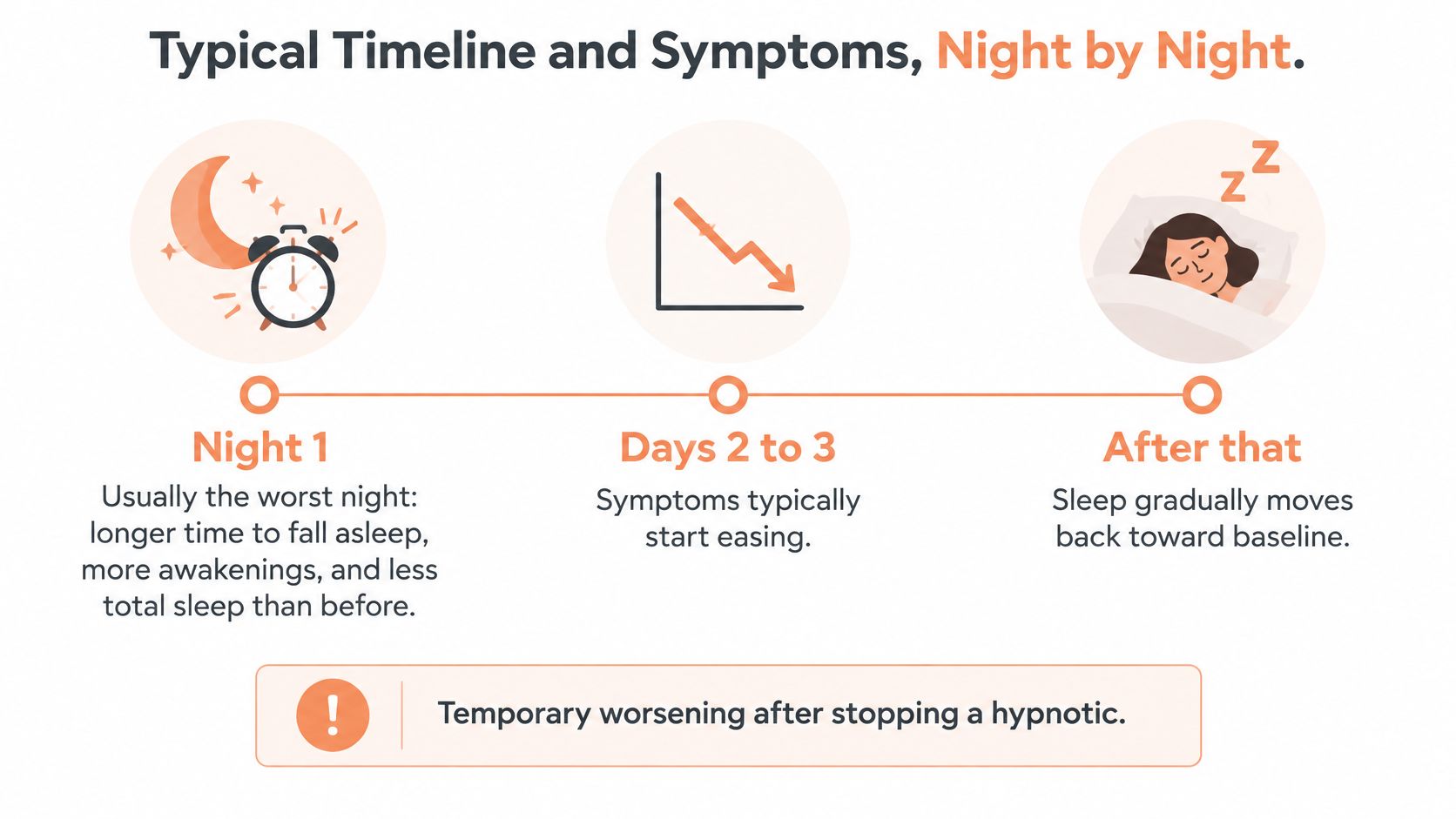
The primary medication-free evening
You would possibly take longer to go to sleep, wake repeatedly, or end the evening sooner than supposed. You may also discover no significant change. Rebound is not inevitable, and the primary medication-free evening would not reliably predict the entire discontinuation course of.
A 2020 randomized discontinuation study published in Sleep adopted 31 adults with insomnia and located no important first-night distinction from baseline, however reported the next final-night outcomes throughout its 2-week discontinuation part.
2020 randomized discontinuation examine outcomes
| Group | Sleep effectivity | Sleep-onset latency |
|---|---|---|
| Stopped instantly, closing evening (n=15) | 87.7% | 14.5 minutes |
| Intermittent use, closing evening (n=16) | 75.9% | 61.5 minutes |
| First discontinuation evening, each teams | No important distinction from baseline | No important distinction from baseline |
This small examine would not set up that intermittent medicine use brought on the poorer outcomes. It does present why medication-taking habits belongs within the sleep report: later difficulties might be missed when you examine solely the preliminary evening.
The next nights
Search for route reasonably than perfection. Falling asleep considerably extra simply, spending much less time awake in a single day, or functioning higher in the course of the day can point out enchancment even when your wearable nonetheless labels restoration as poor.
File early waking, lighter-feeling sleep, fatigue, and focus issues alongside estimated sleep period. These particulars are extra helpful than attempting to interpret a change in a proprietary readiness rating.
Do not flip an anticipated timeline right into a deadline your physique has failed to satisfy.
Because the medicine change progresses, persistent or worsening sleep wants dialogue reasonably than repeated reassurance that it is in all probability rebound. Contact your prescriber earlier when you’re struggling to perform, signs aren’t easing, otherwise you’re uncertain how one can observe the plan.
For an additional clarification of the post-medication sample, this video offers further context.
Methods to Inform Rebound From Recurrence or Withdrawal
Begin with a written baseline earlier than altering medicine. Embrace estimated time to go to sleep, time awake after sleep onset, whole sleep, early awakenings, daytime impairment, and drugs timing.
Hold your present medicated baseline separate out of your recollection or data of pretreatment sleep. The present baseline helps observe a taper; the pretreatment baseline helps decide whether or not sleep has turn into worse than the unique drawback.
Match the sample, not simply the rating
A brief deterioration adopted by motion towards baseline helps rebound. Persistent bother could mirror continual insomnia, circadian misalignment, one other sleep problem, inadequate behavioral therapy, or withdrawal.
Drug-specific proof issues: the FDA’s ramelteon prescribing information studies no proof of rebound after abrupt discontinuation in managed 35-day research.
Matching a sleep sample to its doubtless trigger
| Sample | Probably clarification | What to do |
|---|---|---|
| Transient worsening that peaks quickly after stopping and returns towards baseline | Rebound | Hold logging and observe the agreed plan reasonably than restarting independently |
| Worsening that persists reasonably than easing | Recurrence of continual insomnia or one other sleep problem | Assessment with the prescriber and focus on CBT-I |
| Irregular wake instances, late gentle, or night screens | Attainable circadian misalignment | Assessment sleep timing and light-weight publicity alongside medical causes |
| Sweating, tremor, anxiousness surges, or sensory modifications | Attainable withdrawal | Search immediate medical evaluation, urgently if extreme |
| Confusion, seizures, or harmful daytime sedation | Extreme withdrawal or one other drug-related drawback | Search emergency care now |
These are clues, not diagnoses. Loud night breathing, witnessed respiration pauses, uncomfortable legs, ache, and temper signs could level to further issues that want evaluation.
A wearable cannot reliably distinguish these explanations. Its rating would not inform a clinician if you modified your dose, whether or not you are anxious and shaking, or whether or not you are struggling to remain awake whereas driving. Understanding what insomnia involves can assist you describe the grievance extra exactly.
Signs that override the sleep diary
Seizures, confusion, perceptual modifications, extreme tremor or anxiousness, and harmful sedation want pressing medical evaluation. Do not assume they’re an unusual adjustment to sleeping with out medicine.
In case you’re too sleepy to drive safely, prepare one other solution to journey. If somebody is tough to wake or has irregular respiration, search emergency assist reasonably than ready for a routine appointment.
Managing and Stopping Rebound Insomnia Step by Step
The bad-night rule is to keep away from improvising with medicine. Do not take an additional dose or restart a discontinued drugs due to a tough evening except your prescriber has explicitly included that response in your plan.
Holding the agreed plan does not imply ignoring withdrawal signs. It means utilizing the escalation directions you’ve got organized reasonably than making a frightened dosing determination whereas exhausted.
The fundamental course of is to watch, pause, and make modifications with scientific supervision.
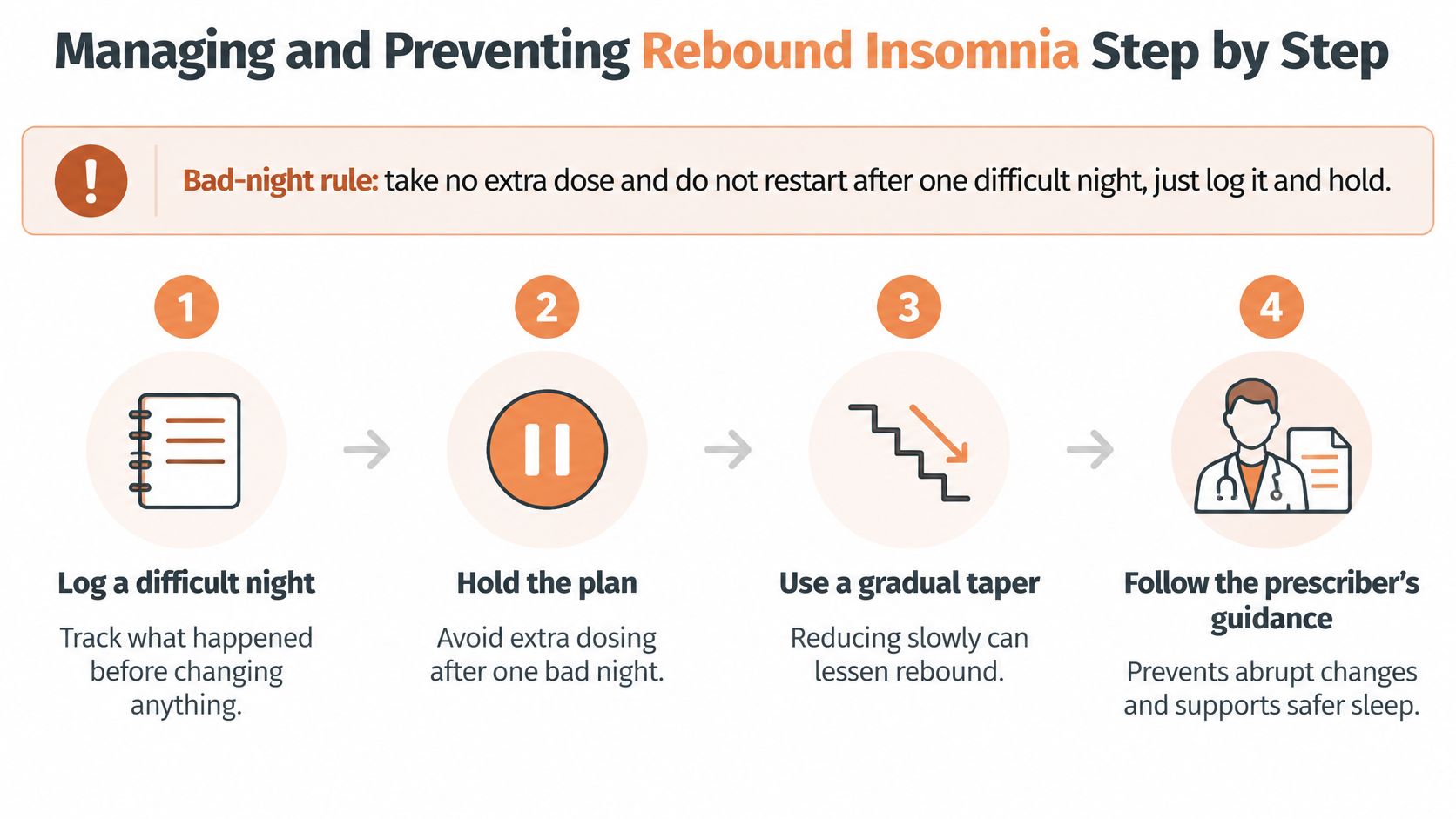
Construct a plan you possibly can observe when drained
-
Set up a usable baseline.
File your typical bedtime, wake time, estimated sleep, medicine use, and daytime functioning earlier than making modifications. A pocket book, spreadsheet, or telephone observe is ample. Use the identical format every morning so you possibly can examine nights with out repeatedly checking the clock in a single day. -
Agree on a medication-specific taper.
Ask your prescriber to put in writing down the dose modifications, timing, formulation, and circumstances that ought to set off a name. Do not assume that chopping tablets or skipping alternate nights is suitable. Some formulations should not be cut up, and a few medicine schedules require particularly cautious reductions.Steering summarized in an international hypnotic deprescribing review describes rebound signs generally lasting about 1–3 days, whereas profitable deprescribing could require weeks to months, notably after long-term or high-dose use.
-
Monitor signs with out turning the evening into an audit.
Make your greatest estimates within the morning. Embrace awakenings, whole sleep, fatigue, focus, and any anxiousness or bodily signs. Exporting Oura or WHOOP traits can add context, however do not change therapy as a result of the system assigned much less deep sleep than you anticipated. -
Enable time to evaluate every change.
Observe the deliberate interval earlier than decreasing once more, and ask whether or not signs warrant holding or modifying the taper. Do not speed up since you’re sleeping nicely or proceed decreasing by means of substantial signs with out checking in. The schedule ought to reply to scientific circumstances, not a self-imposed end date.
Planning rule: Write the difficult-night directions earlier than you want them.
Assist sleep with out chasing it
-
Use CBT-I expertise reasonably than compensating with extra time in mattress.
Hold a constant wake time and go to mattress when sleepy, reasonably than transferring bedtime a lot earlier after a poor evening. In case you’re awake and pissed off, depart mattress for a quiet exercise and return when drowsy.A clinician delivering CBT-I for insomnia can individualize time-in-bed scheduling and tackle concern about sleeping with out medicine. Do not impose aggressive sleep restriction on your self, notably if you have already got extreme daytime sleepiness, a safety-sensitive job, or a situation that requires additional precautions. Keep away from unplanned catch-up naps, however put fast security forward of inflexible guidelines.
-
Scale back avoidable night disruption.
Do not use alcohol as an alternative sedative. Transfer caffeine earlier if it impacts your sleep, end demanding work earlier than your wind-down, and maintain the bed room darkish and cozy. In case you frequently drink closely, focus on alcohol modifications with a clinician as a result of abrupt cessation might be harmful. -
Select a workable interval and put together a setback plan.
A significant launch, in a single day flight, or unusually intense work stretch can complicate each sleep and interpretation. When attainable, coordinate the taper with a extra predictable schedule. Resolve prematurely who you may contact, what signs you may report, and the way you may modify driving or demanding duties when you’re impaired. -
Escalate based mostly on signs and trajectory.
Ask for evaluation if sleep retains deteriorating, functioning turns into tough, or your expertise falls exterior the written plan. You needn’t look forward to a selected variety of dangerous nights to deserve assist. New withdrawal signs require medical recommendation reasonably than one other sleep-hygiene adjustment. -
Prepare ongoing medicine opinions.
Put a follow-up date on the calendar to debate advantages, opposed results, and whether or not the medication nonetheless matches your wants. A profitable evaluation could end in persevering with therapy, modifying it, or tapering additional. Stopping is not the one acceptable final result.
A slower, individualized course of can assist your clinician distinguish short-term adjustment from an unresolved sleep drawback. It would not assure symptom-free discontinuation, and needing a change of tempo is not failure.
Verify Any Change With Your Prescriber First
Do not cut back or cease a sleep medicine with out confirming the plan together with your prescriber. Benzodiazepines should not be stopped abruptly, and different sedative-hypnotics additionally require medication-specific steering.
The frequent assumption is that enduring a tough evening proves you possibly can handle discontinuation alone. It would not. Your prescriber makes the medical advice with you, taking account of the medicine, your well being historical past, and your response.
Carry info the clinician can act on
Carry your sleep report and a whole checklist of prescription medicines, over-the-counter sleep aids, dietary supplements, and alcohol use. Embrace the precise dose and timing you took, not solely what the prescription says.
- Describe the change: Clarify whether or not you take longer to go to sleep, waking extra, or waking too early.
- Present the practical affect: Point out missed work, focus issues, unsafe sleepiness, or issue managing routine tasks.
- Embrace earlier makes an attempt: Word what occurred throughout earlier reductions and whether or not you restarted or modified doses.
Be candid about additional doses or missed doses. Your clinician wants correct info to make the subsequent determination safely.
If sleep stays poor after a supervised taper and medical evaluation, ask about structured behavioral therapy and analysis for different sleep problems. Do not substitute dietary supplements or one other sedating product with out checking for interactions.
Pressing signs take precedence over a scheduled evaluation. In any other case, tonight’s sensible motion is easy: begin the log and prepare an appointment to debate the plan.
The Sleep Advisor provides individualized sleep routines, workload and restoration steering, and ongoing measurement utilizing wearable information and subjective logs. For assist constructing constant sleep habits alongside your prescriber’s medicine plan, go to The Sleep Consultant to discover its distant consulting choices.
Trending Merchandise

COONP King Mattress Topper, Extra T...

CoolShields Waterproof Bed Pads Inc...

Nordic Elk Mattress Bags for Moving...

Waterproof Mattress Protector Twin ...

Utopia Bedding Waterproof Mattress ...

BEDLORE Waterproof Mattress Protect...

Queen Mattress Protector Waterproof...
