
A circadian rhythm is the physique’s inner, roughly 24-hour timing system that schedules sleep, alertness, hormones, physique temperature, and metabolism, and is reset primarily by gentle. It isn’t a set alarm that makes everybody sleepy on the similar hour; it is a set of interacting organic clocks and day by day cues that may shift.
So what’s circadian rhythm in people, past a sleep schedule? Consider it because the timing layer beneath your routines. You possibly can spend sufficient time in mattress and nonetheless really feel worn out in case your inner clock is out of step together with your workday. To grasp what could also be off, separate the clock’s timing from the sleep strain that builds when you’re awake, then search for patterns earlier than altering your schedule.
Desk of Contents
Circadian Rhythm in People at a Look
The physique follows a day-long sample, however its timing is not an identical for everybody. The desk provides a basic image for a day-active grownup with a daily schedule. Chronotype, age, gentle publicity, and day by day routines can all shift when explicit adjustments are noticeable.
| Time of day | Circadian output | What it’s possible you’ll discover |
|---|---|---|
| Round 4–6 AM | Core physique temperature close to its lowest | Deepest sleep strain and the toughest time to wake |
| Round 6–8 AM | Cortisol rising towards waking | Pure alertness begins to construct after you rise up |
| Round 1–3 PM | Publish-lunch dip in alertness | Drowsiness even after a traditional meal |
| Round 4–7 PM | Physique temperature and bodily energy close to peak | Bodily efficiency is commonly at its greatest |
| Round 8–10 PM | Melatonin begins rising, about 2–3 hours earlier than routine sleep | Winding down feels pure; shiny gentle works towards it |
| In a single day | Sleep propensity at its highest | Sleep is best to carry in the course of the organic evening |
These are landmarks, not appointment occasions. Your personal sample would possibly land earlier or later, and it will possibly transfer when your gentle publicity or schedule adjustments. The night melatonin rise, for instance, is tied to routine sleep onset moderately than a common bedtime.
Three concepts are helpful to remember: your physique runs on a day by day sample, gentle helps anchor that sample, and circadian timing is not the identical as feeling drained. The final distinction issues: a sleepy afternoon does not mechanically imply your clock is mistimed, simply as struggling to go to sleep at bedtime does not all the time imply you have not been in mattress lengthy sufficient.
The Physique Clock Inside Each Cell
Suppose an early assembly means you wake earlier than dawn. Your eyes obtain much less daylight than they might later within the morning, however the mind nonetheless has a system for monitoring when day begins. At its heart is the suprachiasmatic nucleus, or SCN, a paired construction within the hypothalamus simply above the optic chiasm. Specialised retinal cells detect gentle and relay info alongside a pathway to the SCN, serving to it align the physique’s inner timing with the surface day–evening cycle. The National Institutes of Health overview of circadian rhythms describes how the SCN coordinates timing throughout sleep, hormones, physique temperature, metabolism, alertness, and habits.
The SCN works like an orchestra conductor. It coordinates subsidiary clocks within the mind and in peripheral organs, together with the liver, intestine, and muscle tissue. These native clocks assist time organ-specific actions, whereas the SCN supplies the broader day by day cue. Gentle is the primary tuning sign, although meals, exercise, stress, temperature, and social routines additionally affect timing.
The rhythm repeats inside cells
The orchestra metaphor additionally suits the mobile degree. Inside cells, clock genes and their proteins work together in suggestions loops that create recurring patterns. In analysis acknowledged by the 2017 Nobel Prize in Physiology or Medicine, Jeffrey C. Corridor, Michael Rosbash, and Michael W. Younger used fruit flies to research the interval gene. The protein it encodes accumulates at evening, is damaged down in the course of the day, and feeds again to inhibit its personal manufacturing. That repeating course of produces an oscillation near 24 hours.
Comparable molecular clock ideas function in folks. The physique’s timing is not a behavior chosen by aware effort; it is constructed into mobile biology and coordinated throughout tissues. For this reason a late evening or a tough early alarm can have an effect on how you’re feeling even while you’re motivated to observe a schedule. Routine may also help reinforce timing, however willpower alone cannot immediately reset the clocks all through the physique.
Why Tiredness and Physique Clock Are Completely different Issues
Extra time in mattress does not remedy each sleep drawback. Sleep strain builds the longer you are awake, very similar to sand filling a jar, and drains throughout sleep. Circadian timing is extra like a tide chart: it adjustments when the physique is of course extra open to sleep or alertness. Your expertise at bedtime displays each processes directly.
Contemplate a founder who wakes at 6 AM and goes to mattress at 1 AM. By midafternoon, they really feel a pointy crash and assume they want extra sleep. Even when they lengthen their time in mattress, that change alone does not essentially shift the organic clock earlier. The identical afternoon dip might return if their timing nonetheless clashes with the calls for of the day.
When sleep strain and timing disagree
The 2 processes can pull in several instructions. After many hours awake, sleep strain could also be excessive, but when your circadian system continues to be selling alertness, falling asleep can stay troublesome. On one other day, your clock could also be approaching its organic evening whereas sleep strain is low since you slept late. You would possibly really feel the window for sleep with out being able to settle simply.
A single wearable sleep rating will not essentially let you know which course of is accountable. It will probably supply helpful estimates, however it will possibly’t by itself distinguish inadequate sleep from a mistimed clock, insomnia, or one other well being challenge. A sensible first verify is to note when sleepiness arrives on days with out an alarm, particularly after you’ve got had time to get better from a demanding week.
Sensible rule: Do not assume {that a} longer time in mattress will right late or early timing. First have a look at when your physique naturally turns into alert and sleepy.
Should you’re additionally exploring how diet merchandise match right into a broader routine, a cell energy supplement guide can supply context, however dietary supplements do not substitute figuring out the timing sample behind sleepiness. Begin by observing the clock, then contemplate period and different attainable causes.
How Gentle, Meals and Exercise Reset the Clock
The physique makes use of day by day time cues, known as zeitgebers, to maintain its rhythms aligned with the atmosphere. Gentle is the strongest cue, and its timing issues greater than including up publicity throughout the day. Shiny gentle within the organic night or early evening usually delays the clock, whereas gentle within the second half of the evening or early morning usually advances it, shifting sleep and wake timing earlier. The peer-reviewed review of human light phase responses describes these timing results.
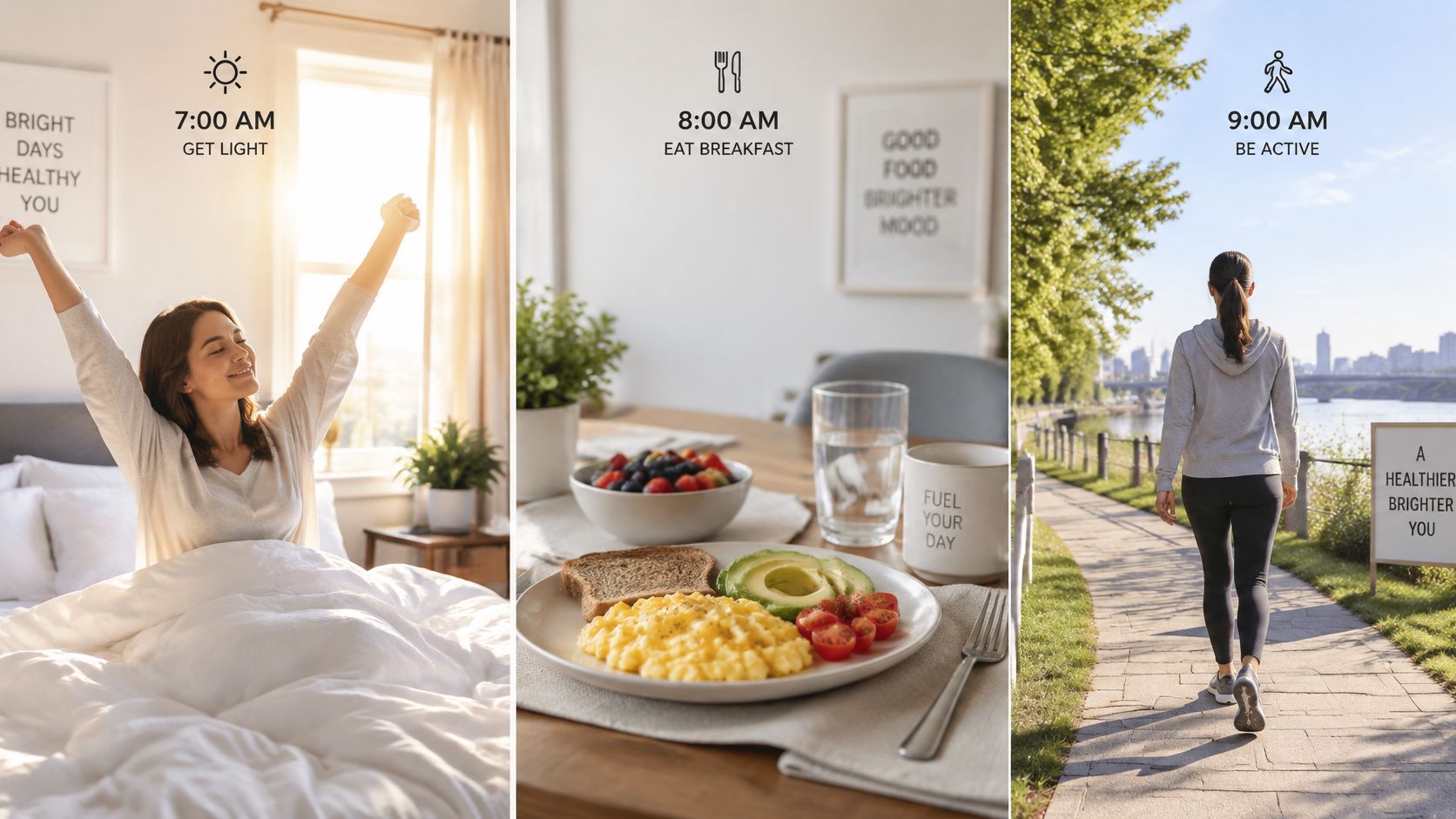
Gentle-response figures can sound extra actual than they’re. In a single managed research summarized within the assessment, 6.7 hours of 10,000-lux white gentle produced a most part delay of about 3.6 hours and a most advance of about 2.01 hours. The melatonin phase-shift response saturated close to 550 lux, reached half-maximum close to 120 lux, and wasn’t measurable under roughly 15 lux underneath the examined situations. These aren’t common directions: responses rely upon gentle spectrum, publicity period, distance, retinal sensitivity, organic part, and particular person chronotype.
| Cue | When it arrives | Typical impact on the clock |
|---|---|---|
| Shiny gentle, outdoor or sturdy indoor gentle | Quickly after waking | Advances the clock, supporting earlier sleep and wake occasions |
| Shiny gentle | Early night into the primary hours of evening | Delays the clock, pushing sleep and wake occasions later |
| Gentle | Second half of the evening or early morning | Advances the clock |
| Dim gentle | Late night | Lets melatonin rise, supporting sleep onset |
| Common meals | Constant day by day consuming window | Helps align peripheral clocks within the liver and intestine |
| Massive late meals | Near bedtime | Can shift peripheral timing and will worsen sleep depth |
| Train | Morning or noon | Helps alertness and a steady day by day sample |
| Mounted work or social wake occasions | Set day by day, typically early | Can pressure a wake time that conflicts with organic timing |
Put the cues in a workable order
Meals and exercise are secondary timing cues. Constant meal occasions may also help coordinate clocks within the liver and intestine, whereas a gentle sample of motion helps a extra predictable day by day routine. Mounted social or work schedules may impose a wake time that does not match your pure timing. For sensible methods to consider night screens and illumination, see this information to blue-light exposure and sleep timing.
A late-working government can begin with a easy sequence: get sturdy gentle quickly after waking, scale back shiny or blue-enriched gentle late within the desired night, and hold meals at constant occasions. Select the timing primarily based on the particular person’s precise sleep sample, not solely the clock on the wall. Over one to 2 weeks, search for a gradual change in sleepiness and wakefulness moderately than anticipating an instantaneous reset.
This video provides one other introduction to gentle and day by day timing.
Early Birds, Evening Owls and Everybody Between
Chronotype is a pure, biologically primarily based desire for sleep timing and peak alertness. It is not a rating for self-discipline. Somebody who prefers an earlier day and somebody who feels sharper later might each have peculiar organic variation; problem typically grows when a required schedule conflicts with an individual’s timing.
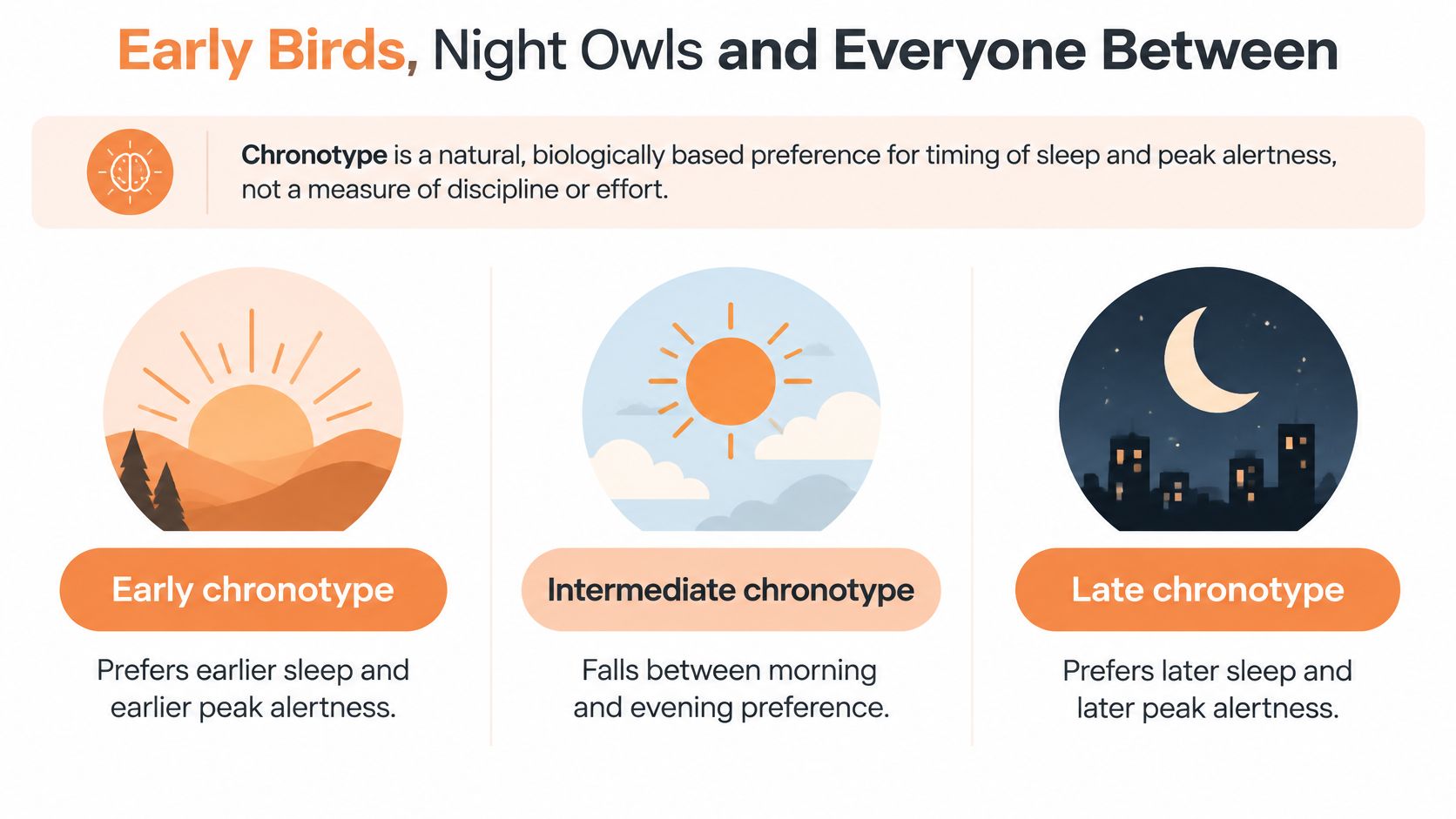
| Chronotype | Typical timing sample | Peak alertness | Schedule match |
|---|---|---|---|
| Early sort (morning) | Falls asleep early within the night and wakes early with out an alarm | Early morning | Early work blocks match nicely; look ahead to late social occasions |
| Intermediate sort | Sleep timing sits close to the center of the inhabitants vary | Late morning to early afternoon | Most traditional schedules match with modest gentle administration |
| Late sort (night) | Sleep onset drifts late and waking earlier than a set early alarm is tough | Late afternoon to night | Wants morning gentle and dimmer evenings to suit early work |
| Excessive early or late sample | Sleep timing far exterior the everyday vary, typically persistent | Can differ broadly | Assess earlier than forcing a schedule |
The mismatch is commonly social, not private
Synthetic night gentle can delay most well-liked sleep timing. A modeling research mentioned in Scientific Reports’ analysis of light, sleep, and social schedules discovered that this shift can create social jet lag when required wake occasions conflict with organic timing. The research additionally predicted that decreasing night gentle might assist greater than transferring work or faculty later, particularly for folks with slower clocks.
The discovering doesn’t suggest that extra gentle is mechanically higher for everybody. A big nationally consultant evaluation discovered that larger gentle publicity correlated with an earlier chronotype, but it surely did not set up that gentle brought about higher psychological well being. The helpful query isn’t just whether or not you get shiny gentle, however which publicity issues, when it arrives, and for whom.
To estimate your individual sample, observe sleep and wake occasions on days with out an alarm after you’ve got had a number of days to get better from quick sleep. In case your most well-liked timing stays persistently late, that is extra informative than one late evening. A hard and fast early alarm can conceal the distinction between a naturally late rhythm and a brief shift attributable to stress, journey, or amassed sleep loss.
Frequent Disruptions and Their Results on Sleep
Circadian disruption occurs when habits and the atmosphere repeatedly battle with inner timing. Jet lag is a transparent instance: after crossing time zones, the physique clock can lag behind native time, leaving you awake or hungry at inconvenient hours. Work schedules, altering meal occasions, stress, and sickness can produce totally different types of mismatch.
| Disruption | Essential timing battle | Typical results | Sensible repair |
|---|---|---|---|
| Jet lag | Physique clock lags behind vacation spot native time | Early waking, daytime fatigue, poor urge for food | Search morning gentle on the vacation spot, shift meals progressively, permit a number of days to regulate |
| Rotating or evening shifts | Work hours fall within the organic evening | Fragmented daytime sleep, sleepiness in the course of the shift | Use blackout curtains for daytime sleep, anchor meal occasions, use shiny gentle at shift begin |
| Irregular schedule | Wake occasions and meals change from day after day | Unpredictable sleepiness and sleep onset | Repair one wake time first, then stabilize meals and night gentle |
| Sickness or stress | Stress hormones and sleep loss blur cue timing | Irregular sleep, daytime fatigue, low temper | Preserve wake time and meals regular till restoration |
For folks working nights or rotating shifts, the guide to shift work and sleep provides related planning context. Blackout curtains may also help make daytime sleep situations darker, whereas constant meal timing provides the day a extra predictable construction. Shiny gentle in the beginning of a shift might assist alertness, however the precise timing relies on the shift sample and the aim for sleep afterward.
Sleep aids and a mistimed clock
The CDC National Health Interview Survey summary stories that 12.9% of U.S. adults in 2024 used sleep aids most days or day-after-day to assist them fall or keep asleep. That determine displays sleep-aid use, not a measure of circadian disruption.
Treatment might assist with sleep on a given evening, but it surely does not essentially transfer a clock that is out of alignment with work or daylight. If the timing battle stays, the identical problem can return. For persistent issues, focus on sleep aids and different signs with a clinician moderately than attempting to regulate remedy or timing aggressively by yourself.
Verify Your Physique Clock Earlier than You Change It
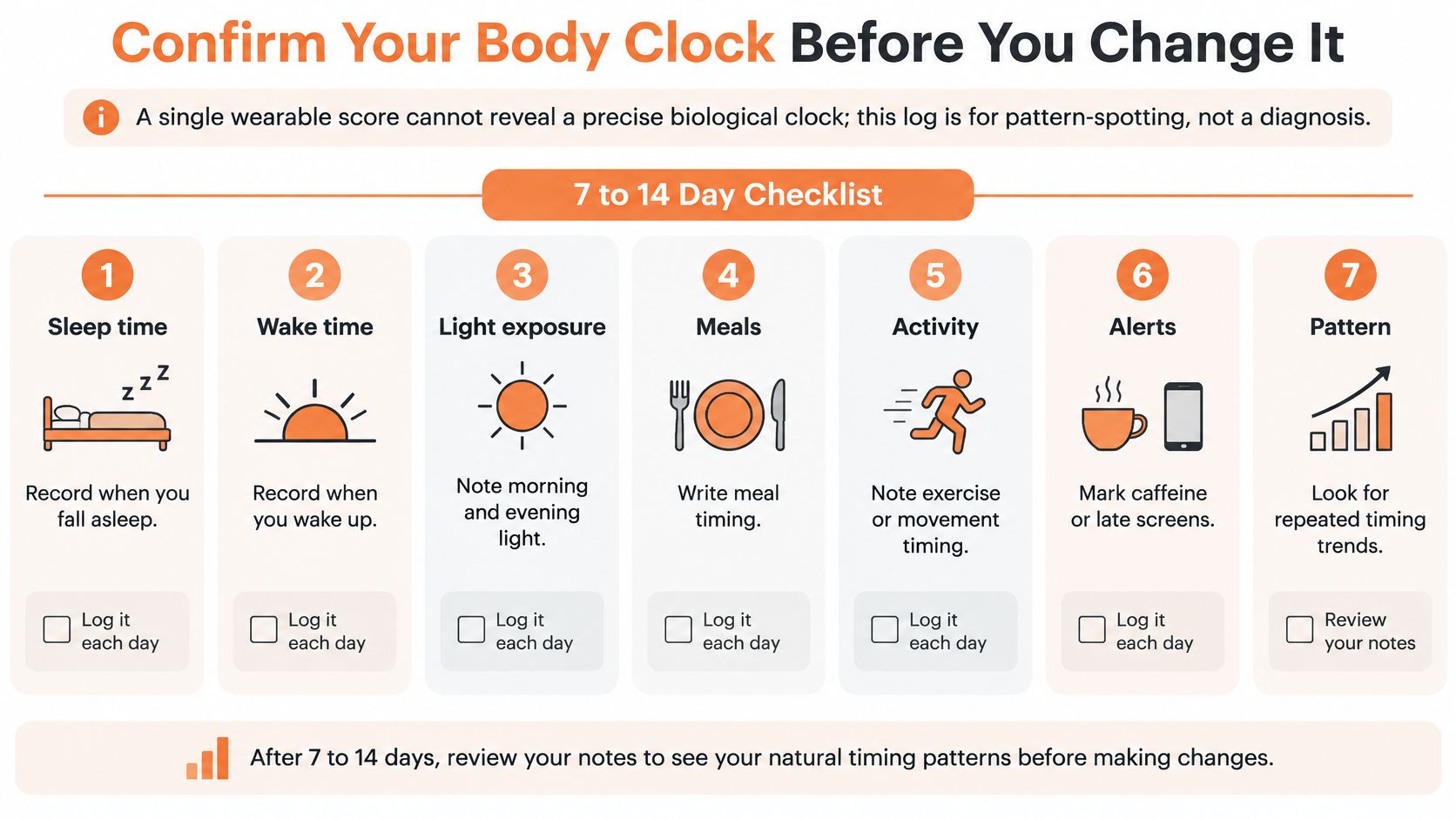
A wearable may also help you discover patterns, however one sleep rating cannot reveal your exact organic clock. A brief log is extra helpful for recognizing whether or not your timing repeats or shifts with journey, sickness, stress, or work. Deal with it as pattern-spotting, not analysis.
Preserve a easy day by day file
For 7 to 14 days, file:
- Sleep and wake occasions. Word while you suppose you fell asleep and while you woke, together with days off.
- Sleepiness and application. Mark while you really feel most awake, while you dip, and when night sleepiness begins.
- Gentle publicity. Word morning and night publicity, together with out of doors gentle and shiny indoor settings.
- Meals and exercise. Report while you eat and while you train or transfer.
- Mounted calls for. Write down required wake occasions, work shifts, journey, or different schedule limits.
- Signs. Word persistent problem falling asleep, unrefreshing sleep, loud loud night breathing, or gasping throughout sleep.
These signs can level to sleep apnea, insomnia, or one other well being challenge, moderately than circadian misalignment. Convey them to a clinician for evaluation. The clinical framework on personalized circadian assessment cautions towards treating wearables, inner part measures, mobile timing, and molecular info as interchangeable. It additionally emphasizes that some timing traits could also be comparatively steady whereas others change with circumstances.
In case your sleep stays persistently late towards a set wake time and your log does not elevate medical issues, change one cue at a time. Begin with morning gentle, then contemplate night gentle, adopted by meal timing. Give every change one to 2 weeks earlier than judging it, and examine a number of weeks of data to separate your typical sample from short-term disruption.
Preserve the log helpful: If the sample stays unclear, or signs persist regardless of a gentle routine, search skilled recommendation earlier than attempting a strict chronotype-based schedule.
For an additional structured approach to replicate in your pure timing, do that chronotype assessment. It will probably add context to a log, but it surely should not substitute medical screening when signs recommend a sleep problem or one other well being concern.
The Sleep Marketing consultant provides individualized sleep protocols that contemplate circadian timing, gentle publicity, routines, and ongoing measurement for busy professionals. If you’d like assist making sense of your patterns and constructing a sensible plan round your schedule, go to The Sleep Consultant.
Trending Merchandise

COONP King Mattress Topper, Extra T...

CoolShields Waterproof Bed Pads Inc...

Nordic Elk Mattress Bags for Moving...

Waterproof Mattress Protector Twin ...

Utopia Bedding Waterproof Mattress ...

BEDLORE Waterproof Mattress Protect...

Queen Mattress Protector Waterproof...
