
Cognitive shuffling is a bedtime psychological train developed by researcher Luc Beaudoin, during which you image a stream of random, unrelated, impartial issues, switching each 5 to fifteen seconds, to crowd out worries and mimic the scattered ideas of falling asleep. The proof is early: a couple of small research, together with one convention report on 154 college students. It might assist most when racing ideas maintain you awake, however it’s no substitute for treating insomnia. To attempt it, decide a impartial phrase, then image unrelated phrases that begin with every letter, with out linking them. Cease if it makes you extra alert or pissed off. In case you are awake usually or for weeks, see a clinician and ask about CBT-I. That is instructional data, not medical recommendation.
What’s cognitive shuffling?
Cognitive shuffling is a psychological method for falling asleep. Researcher Luc Beaudoin of Simon Fraser College developed it greater than a decade in the past and calls it serial various imagining. You consider a impartial, nice goal, then maintain switching to unrelated ones, usually each 5 to fifteen seconds.
The concept rests on how sleep begins. The pure drift into sleep is marked by sensory imagery, switching off of upper considering, and hallucination-like photos. Individuals with insomnia are likely to assume in another way in mattress. In a single examine, individuals with sleep-onset insomnia targeted extra on worries, issues, and noises, and fewer on “nothing particularly,” than good sleepers. In addition they discovered their ideas extra occupying and tougher to regulate.
Beaudoin describes two sorts of bedtime ideas. Insomnolent ideas, similar to worrying, planning, rehearsing, and ruminating, work in opposition to sleep. Professional-somnolent ideas, similar to dream-like imagery, work with it. Cognitive shuffling tries to interchange the primary sort with the second.
How do you do cognitive shuffling? A step-by-step information
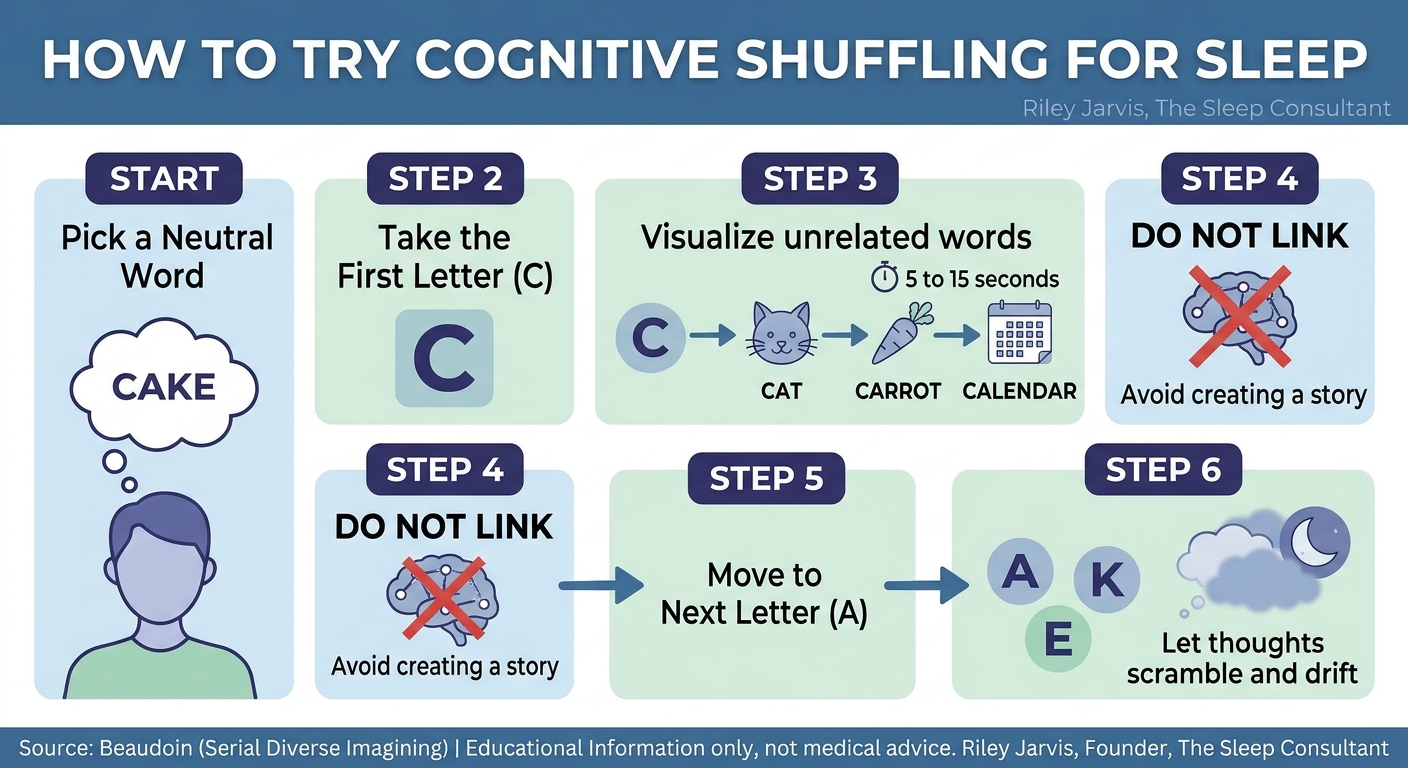
Right here is the model most frequently described. It takes no instruments, and also you do it together with your eyes closed in mattress:
- Choose a random, impartial phrase, with no emotional cost. For instance, “cake.”
- Take the primary letter (C) and consider a phrase that begins with it, similar to cat, carrot, or calendar.
- Image every phrase for about 5 to fifteen seconds.
- Don’t hyperlink the phrases or attempt to make sense of them. Your mind loves to search out which means, and the train works by resisting that.
- Transfer to the following letter (A) when you find yourself prepared, and repeat. Proceed by every letter, then decide a brand new phrase, till you drift off.
- Let it blur. If photos fade or your ideas scramble, that’s the level.
One printed instance has a girl considering “blanket,” then bicycle, then shopping for footwear, then a banana tree. Preserve it mild. If a fear pops up, return to the following phrase with out arguing with it.
Beaudoin admits it’s not simple. He says the human mind is a sense-making machine, and it’s exhausting for individuals to conjure up random photos unaided.
Does cognitive shuffling work? What the proof says
It would, however the proof is early and restricted. Right here is the trustworthy image:
- The principle examine is a convention report. At SLEEP 2016, Beaudoin’s workforce introduced a examine of 154 college college students who complained of extreme pre-sleep psychological arousal. Serial various imagining was as efficient as a structured problem-solving train at decreasing pre-sleep arousal, sleep effort, and poor sleep high quality, with the benefit that it may be finished in mattress. This was an summary introduced at a convention, not a full peer-reviewed trial.
- There are few research. Sleep scientists observe that analysis continues to be in its infancy and that solely a small variety of research exist.
- A battle of curiosity exists. Beaudoin created a associated app known as mySleepButton, so the strongest advocate can be a developer.
- Psychological tips can backfire. A 2020 systematic assessment of pre-sleep cognitive exercise discovered that psychological imagery, hypnosis, paradoxical intention, thought suppression, and distraction had results that have been helpful, negligible, or detrimental. Making an attempt to suppress pre-sleep ideas has been linked to longer sleep onset instances and worse sleep high quality.
The underside line: it’s a low-risk experiment, not a confirmed remedy. Strive it gently for a couple of nights, and choose by how you are feeling.
Does your thoughts race each night time, no matter you attempt? That may level to a root trigger behind the scenes, similar to stress physiology, blood sugar swings, or your physique clock.
If you need to see how we would have the ability that can assist you with this deeper, schedule a free consult here.
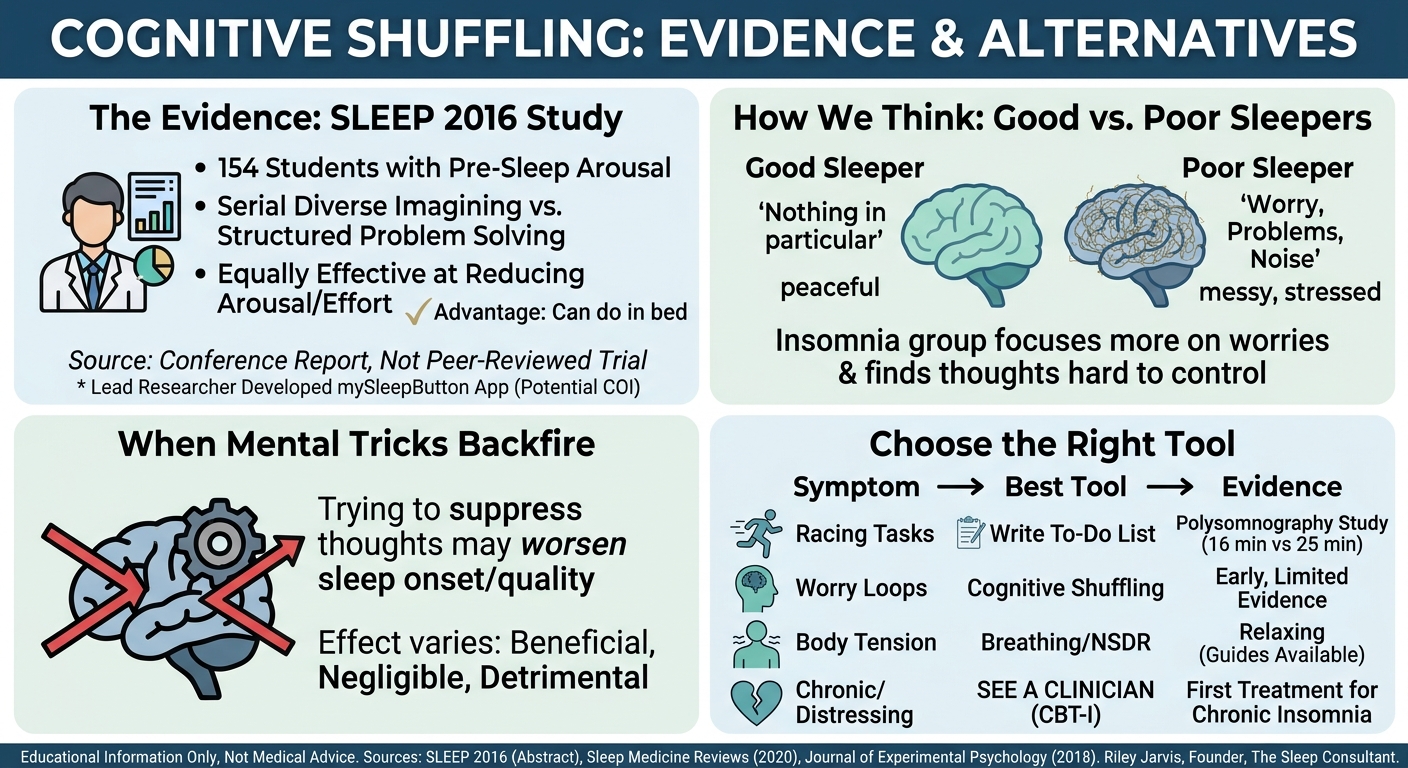
Completely different issues want completely different instruments. Match the instrument to what’s taking place:
- Your head is filled with tomorrow’s duties. Write a to-do listing for 5 minutes earlier than mattress. It has higher proof than cognitive shuffling (see under).
- Worries loop as soon as you might be in mattress. Strive cognitive shuffling, and maintain expectations modest.
- Your physique feels tense or wired. Use respiration or leisure. See our guides to 4-7-8 breathing for sleep and NSDR for sleep.
- You’re awake for lengthy stretches, or this has lasted weeks. See a clinician and ask about CBT-I.
For extra bedtime techniques, learn how to fall asleep fast and our information to racing thoughts at night.
When does cognitive shuffling not work?
It might not assist if:
- You attempt too exhausting. Forcing your self to go to sleep raises effort and application. In case you discover that, cease and calm down.
- Your ideas are intrusive or distressing. Persistent anxiousness, panic, or trauma-related ideas want greater than a distraction train.
- You wrestle to image photos. Consider the phrases as a substitute, or attempt one other instrument.
- Your insomnia is power. One method doesn’t deal with it. If in case you have hassle sleeping not less than three nights every week for 3 months, ask about CBT-I.
If in case you have been awake some time and really feel wired, stand up and do one thing calm in low mild till you are feeling sleepy. See how to break the anxiety and insomnia cycle.
What the Analysis Exhibits
Poor sleepers assume in another way at bedtime. In a 2000 examine within the British Journal of Scientific Psychology, 30 individuals with sleep-onset insomnia and 30 good sleepers have been interviewed about their pre-sleep ideas. The insomnia group targeted extra on worries, issues, and noises within the atmosphere, and fewer on “nothing particularly.” In addition they described their ideas as extra occupying, much less intentional, longer lasting, and extra of a barrier to falling asleep. A 2020 systematic assessment provides that the traditional transition to sleep includes sensory imagery and the switching off of upper cognitive processes.
Serial various imagining: promising, however early. In a examine introduced at SLEEP 2016, Beaudoin and colleagues examined the method in 154 college college students with extreme pre-sleep arousal. It was as efficient as structured drawback fixing at decreasing pre-sleep arousal, sleep effort, and poor sleep high quality, with the added benefit of being finished in mattress. The information come from a convention report, the members have been college students, and the lead researcher developed a associated app.
Some psychological methods assist, and a few backfire. The 2020 assessment in Sleep Medication Opinions checked out methods for manipulating pre-sleep considering, together with psychological imagery, hypnosis, paradoxical intention, thought suppression, and distraction. Their results have been helpful, negligible, or detrimental, and the authors known as for extra analysis on mechanisms. In an experiment by sleep researcher Allison Harvey, individuals informed to suppress their pre-sleep ideas estimated that they took longer to go to sleep and rated their sleep high quality as poorer than individuals given non-suppression directions.
Writing tomorrow’s to-do listing has stronger proof. A 2018 examine within the Journal of Experimental Psychology: Common used in a single day polysomnography in 57 younger adults. Those that wrote a five-minute to-do listing fell asleep in about 16 minutes, in contrast with about 25 minutes for many who listed accomplished duties. Individuals who wrote very particular lists fell asleep even quicker. The examine was small and used wholesome 18- to 30-year-olds in a lab, so outcomes could differ at house.
This text is for training solely and isn’t medical recommendation. Discuss with a certified clinician about your personal sleep, well being situations, and drugs. If you need to see how we would have the ability that can assist you with this deeper, schedule a free consult here.
Desire a hand quieting a busy thoughts at night time?
Be part of The Sleep Nirvana Membership, our free sleep course and group: Join the free sleep course and community.
When to Search Skilled Assist
- You have got hassle sleeping not less than three nights every week and it has lasted weeks to months. The American School of Physicians recommends CBT-I as the primary remedy for power insomnia.
- Your ideas at night time are distressing, intrusive, or tied to trauma, panic, or fixed fear. A psychological well being skilled will help.
- You are feeling persistently unhappy or hopeless, or have ideas of self-harm. Contact a clinician immediately, and within the US you may name or textual content 988 at any time.
- Your ideas race and you’ve got uncommon power with no need for sleep for days. This is usually a signal of a temper episode, so discuss with a clinician promptly.
- You snore loudly, gasp or choke at night time, or really feel very sleepy by day. These can sign sleep apnea.
Continuously Requested Questions
What’s cognitive shuffling?
Cognitive shuffling is a bedtime psychological train developed by researcher Luc Beaudoin, who calls it serial various imagining. You image a stream of random, unrelated, impartial issues, switching about each 5 to fifteen seconds, so your thoughts stops looping on worries. The concept is to imitate the scattered, dream-like ideas individuals have as they go to sleep. It’s fashionable on-line, however analysis on it’s nonetheless early and restricted.
Does cognitive shuffling actually work?
It would, however the proof is early. A 2016 convention report on 154 college college students discovered it diminished pre-sleep arousal, sleep effort, and poor sleep high quality about in addition to a structured problem-solving train. There are few research, and the researcher who developed it additionally created a associated app. A broader assessment discovered that bedtime psychological methods might be useful, impartial, and even dangerous, so attempt it gently and cease if it frustrates you.
How do you do cognitive shuffling for sleep?
Lie in mattress together with your eyes closed and decide a impartial phrase, similar to cake. Take the primary letter and consider an unrelated phrase that begins with it, picturing each for about 5 to fifteen seconds. Don’t hyperlink the phrases or attempt to make sense of them. When you’re prepared, transfer to the following letter, and repeat till you drift off or end the phrase. Then select a brand new phrase.
How lengthy does it take for cognitive shuffling to work?
No examine offers a timeline, and it might take apply. Specialists who describe the method say to not be disheartened if you don’t see outcomes immediately, and that what works for some individuals is not going to work for others. Give it a good trial over a number of nights, and maintain expectations mild. In case you are nonetheless awake after some time, stand up and do one thing calm till sleepy. If it doesn’t assist, attempt one other instrument or ask about CBT-I.
What else helps with racing ideas at night time?
Writing tomorrow’s to-do listing for 5 minutes earlier than mattress has the most effective proof amongst easy instruments. In a polysomnography examine of 57 younger adults, individuals who wrote a to-do listing fell asleep about 9 minutes quicker than those that listed accomplished duties. For persistent insomnia, the American School of Physicians recommends cognitive behavioral remedy for insomnia (CBT-I) because the first-line remedy. Respiration workouts and leisure may assist in case your physique feels wired.
When to Work With a Sleep Advisor
In case your thoughts races most nights, a deeper trigger could also be concerned: your stress response, blood sugar swings, circadian rhythm, hormones, or nutrient standing. The Sleep Advisor appears for these root causes as a substitute of handing you generic sleep-hygiene ideas, so a psychological trick will not be carrying the entire load.
Schedule a free sleep assessment.
Trending Merchandise

COONP King Mattress Topper, Extra T...

CoolShields Waterproof Bed Pads Inc...

Nordic Elk Mattress Bags for Moving...

Waterproof Mattress Protector Twin ...

Utopia Bedding Waterproof Mattress ...

BEDLORE Waterproof Mattress Protect...

Queen Mattress Protector Waterproof...
